Here’s my latest post on my YouTube channel, with policy wonk and academic Dinesh D’Souza discussing Tucker Carlson’s recent conspiracy theories, which are unfortunately shared by a lot of influential people.
I’ve got some good stuff on this channel, I encourage you to subscribe!
Now that we’ve gotten to see Barack Obama lecture black men about how “they ain’t black” if they don’t vote for Harris, I thought it would be a good time to share my video about why liberals hate black conservatives.
This may also be a good time to take a step back and remind ourselves, or be reminded if we haven’t heard, that Barack Obama has no personal or historical connection to “The Black Experience” in America. Like me, he is half-white, but unlike me, the black side of his family are not descendants of slavery, meaning that he personally does not have a historical connection to slavery in his family lineage, with all the generational difficulties and trauma that entails.
He did not “live The Struggle” as you might say, and he has absolutely no connection to “The Black Struggle” as it is commonly understood in the context of American history and society.
Note too that while plenty of white Americans, immigrants, and people of all backgrounds and races live hard lives, face financial hardship, and have to scrape and fret to survive, he did not experience that life, either. His parents met in a Russian class at the University of Hawaii, where his father was studying economics as a visiting student from Kenya, before going on to get a Master’s in economics at Harvard. Upon graduating from Harvard, his father “married for a third time and worked for the Kenyan government as the Senior Economic Analyst in the Ministry of Finance.” While Barack Jr. was alienated from his father at a young age, his parents were both of the educational elite, and he did not grow up in a manner that is in any way thought of or associated with “The Black Experience” in America. When it comes to persevering and overcoming hardship, Bill Clinton had a much more typical childhood associated with that sort of experience than Barack Obama did. In fact, none other than Nobel Prize-winning author Toni Morrison called Clinton “our first black President…[b]lacker than any actual black person who could ever be elected in our children’s lifetime.”
Some may say that her words remain true over two decades later….
A few other things separate Barack Obama’s childhood and experience from that of your typical black American, or even from your typical American. Four years abroad in elementary school in Jakarta, Indonesia, living with his mother and another foreign father figure in his stepdad, where he supposedly became fluent in Indonesian. Attending an Ivy League feeder prep school in Hawaii, while living with his grandfather and grandmother, who was a Vice President at the Bank of Hawaii. And of course attending Columbia University and Harvard Law School in the 1980s.
The reason this is important is because of the absolute incongruity if not insanity of a man like this lecturing black men about their duty to vote for Kamala Harris as if he’s one of them, indeed an elder among them, and because she is like them, and their mothers and their sisters. Whatever internal strife, identity crises, and life struggles he has had, they are not the same kind of struggles that most black men in America have faced, and it is both insulting and condescending for him to carry himself that way in order to talk down to black men and to voters.
As to his actual critique that black men are failing to support a candidate who “understands them,” Harris’s family history and childhood are just as atypical and removed from the average African American experience as Obama’s is. Her mother was an Indian immigrant with a Ph.D from Berkeley, which led to a career as a cancer researcher. Her father also has a Ph.D from Berkeley and was the first black professor to be granted tenure in Stanford’s economics department.
So when Obama says she “grew up like you, knows you…understands the struggles, and pain, and joy that comes from those experiences,” that she has “had to overcome” to achieve in life…I really have to wonder what he means. Does he mean overcome the struggle of having two parents with Ph.Ds from an elite school, one a medical researcher and one a prestigious economist? Does he mean the pain of growing up in Berkeley and then Montreal, attending an elite public high school in a wealthy neighborhood? When he says she has “shared experiences” with them, perhaps he means when she “went ta college wit’cha,” which I’m sure is the dialect he uses behind closed doors at his mansion in Martha’s Vineyard and how he talked while at Columbia and Harvard.
Or perhaps it turns out that her “shared experience” of “The Black Struggle” is just as fake as his, as much of a cheap racial pander playing on stereotypes as any low rent “hot sauce in my purse” type of trick. And perhaps Bill Clinton really is our first, and only, black president.
While we’re at it, and since we’re having so much fun, I’ll include my video about the left’s vicious smears against a black man who rose from literal dirt poverty to the highest court in the land.
To understand how Barack Obama is more of a self-made myth than a self-made man, I highly recommend this interview with Obama biographer David Garrow, and Garrow’s subsequent interview with Megyn Kelly. Alone or together, these two pieces utterly annihilate the Obama Myth. If you care enough to have an opinion about Barack Obama, these are required reading and viewing. And if you know anyone who has an opinion about him, you should share these as well.
And to pierce the veil on the Kamala Harris Myth, I recommend this excellent piece by Ben Shapiro. Like the pieces on Obama, this one completely undermines and refutes her claimed “humble” upbringing as a “middle class kid” who identifies with “The Black Struggle.”
If you liked this article, please subscribe to my blog by clicking the blue “Follow” button in the upper right corner (at the bottom of the article if you’re on your phone or tablet) to receive an email every time I post, which isn’t that often. And of course feel free to share it if you know someone else who may enjoy it.
We have a strong safety net. Why doesn’t it always work? Why doesn’t it keep everyone out of poverty?
If we just spend enough money and make the safety net big enough, will that end poverty? Or will people make decisions that keep them in poverty no mater how much money we spend on the safety net?
Is there a magic bullet or recipe that can help someone escape poverty? Turns out: there is. Economic researchers who study poverty have found 3 choices people make that almost entirely determine whether they escape poverty or remain in poverty.
The good news for those in poverty is that the power to improve their lives is entirely in their hands.
The bad news for those in poverty is that the power to improve their lives is entirely and only in their hands.
This gets right to the heart of the discussion about the solution to poverty, and whether “taxing the wealthy a little bit more” as Jamie Dimon says is actually the cure.
Here I explore some of the questions from my last post about the idea that “taxing the wealthy a little bit more” will cure or substantially reduce poverty and the hardships faced by the poor.
Should there be a social safety net?
Does everyone agree that there should be a safety net?
What causes someone to be poor? The answer could be that you’re born poor. In that case it’s easy to determine.
But not everyone who is poor now was born poor. If that’s the case, what are the factors that caused them to move from say the middle class down the economic ladder?
What keeps them poor? Is it primarily a lack of money? Or is it personal choices, culture, and family?
Some people, many people in fact, do escape poverty, so it clearly is possible. How do they do it? Do social welfare and government programs get them out of poverty? Or is it their own choices and lifestyles, over the long haul?
What’s the difference between successful cultures, families, and individuals, and unsuccessful ones?
Would you like to know the answer to this question? Well, I’ll tell you!
In my last video, I addressed comments made by JP Morgan CEO Jamie Dimon that he would tax the wealthy “a little bit more” to alleviate the problems of the poor. I asked and addressed who he means by “The Wealthy” who should be taxed more to solve these problems.
Here I address whether money is actually the solution for the problems that the poor face, and whether his premise even makes sense or is accurate.
Here is the testimony of an economic expert who studies poverty that lists the three-pronged “cure” for poverty mentioned in my video.
This is a long, dense read, that I don’t necessarily recommend taking the time for, but here is a very important nugget from this testimony that is quite frankly the “Magic Bullet” for poverty that we’ve been looking for. I find it strange that these three factors are virtually unknown to anyone and almost never talked about. We should be talking about them constantly if we want to help people make their lives better and reduce overall poverty. Everyone in America, especially all politicians and policymakers, as well as people who are interested in politics, society, and the good of mankind should know and talk about these three factors whenever helping the poor and alleviating poverty come up.
Strategies to Reduce Poverty
Although the dramatic increase in federal spending has not led to an overall reduction in the nation’s poverty rate, at least two strategies have been successful in reducing poverty within specific demographic groups. Both should be considered major successes of the nation’s social policy and both could be extended. The first is to give money to people who are not expected to work and the second is to use welfare policy to strongly encourage work and then to subsidize earnings because so many of the poor have low skills and often cannot earn enough to escape poverty.
Before reviewing these and other strategies for reducing poverty, I want to emphasize the importance of individual initiative in reducing poverty and promoting economic success. My Brookings colleague Isabel Sawhill and I have spent years emphasizing the importance of individual responsibility in reducing poverty and increasing opportunity. One of our arguments, based in part on a Brookings analysis of Census Bureau data, is that young people can virtually assure that they and their families will avoid poverty if they follow three elementary rules for success – complete at least a high school education, work full time, and wait until age 21 and get married before having a baby. Based on an analysis of Census data, people who followed all three of these rules had only a 2 percent chance of being in poverty and a 72 percent chance of joining the middle class (defined as above $55,000 in 2010). These numbers were almost precisely reversed for people who violated all three rules, elevating their chance of being poor to 77 percent and reducing their chance of making the middle class to 4 percent. [25] Individual effort and good decisions about the big events in life are more important than government programs. Call it blaming the victim if you like, but decisions made by individuals are paramount in the fight to reduce poverty and increase opportunity in America. The nation’s struggle to expand opportunity will continue to be an uphill battle if young people do not learn to make better decisions about their future.
Here is a discussion about some other aspects of poverty from the esteemed economist Thomas Sowell.
Here is a blog post where I talk about the value of economic thinking generally, as a way to see things more clearly on a topic like this.
Yesterday I saw a video of JP Morgan CEO Jamie Dimon recommending taxing the wealthy more to help the poor so that they can have better schools, health care, and so on.
But who exactly does he mean? Who are “The Wealthy?”
Him, of course. But who else?
Your doctor? Your lawyer? Your dentist? Your plumber? You?
I explore who is or who should be described as “wealthy” both logically and morally, and for tax and policy purposes.
How would you define who is “wealthy?” Someone who makes $100,000 a year? $200,000 a year? $400,000 a year? A million?
Or does annual income matter less than net worth and assets?
What if your salary is $1 a year but you hold $1 billion in stock? Who’s wealthier, you or the lawyer making $500,000 a year?
Should the lawyer who makes $200,000 a year be taxed as much as Jeff Bezos? Should the couple working 80 hours a week and making $400,000 a year combined be taxed like a billionaire who never has to work again? Should we treat income earners of any kind like those with high net worth and assets?
Who counts as “wealthy?”
People say “Tax the wealthy” as a shorthand for fixing social problems and helping the poor.
But who are “The Wealthy?”
Is a 200k professional “The Wealthy” to be taxed like Wall Street millionaires?
During the summer of 2020, as Minneapolis was going through some combination of protests during the day and riots at night (and it genuinely was a “night and day” phenomenon), one of the most significant events that took place was the assault on and burning of the 3rd Police Precinct, home to the police officers involved in the death of George Floyd.
The burning of the 3rd Precinct is one of the stories of the 2020 riots documented in the new movie The Fall of Minneapolis, which was released in November. This movie explores the events of that summer in-depth, and details many facts and events that have been unreported until now. I highly recommend watching it to understand both what happened in Minneapolis that summer, and the effects that George Floyd’s death and the subsequent protests and riots have had on the rest of the country. You can watch it here, here, or here.
The same day the movie was released, I attended a community meeting in the neighborhood where the building was located, for a public forum on the city’s plans to rebuild the police station, as well as some type of “community services” to be located in the building as well. As the article notes, I am fairly confident that I am the only person in that meeting who wanted the police to exist at all, and I am sure that I was the only one comfortable with the very notion of a building that houses police in general.
You may think I’m exaggerating, but unfortunately I am not. The exact reason I went was to see for myself what the community response is to having a rebuilt police station in their neighborhood, and to use the word “hostile” would just be a laughable understatement, and do a gross injustice to the hatred of police permeating this room. Some things have to be seen to be believed. And I saw it.
I knew going in that the overall sentiment would probably be anti-police, but it was so much more intense than even I thought it would be, as cynical and jaded as I am. This is why I reported on the story, which was not my original intent. My only thought going in was just to see for myself, to help understand public perception of this issue, and to hear what people had to say. As the tone of the forum got crazier and crazier, I began to think “Oh my god. People need to hear this.” And that feeling only increased as the meeting went on.
As a result, I published my first piece for local news outlet Alpha News. Below is my piece, as well as some background information. I hope you find it interesting and informative, and if you do, please share it with your friends as well.
Here is my Twitter post explaining the background of my reporting on this story
Good morning friends. I want to share with you my first piece for Alpha News, the producers of the new documentary The Fall of Minneapolis, which documents how the officials who run Minneapolis and the state of Minnesota let our city be looted and burned for days on end, and how…
Here is the Facebook post of the story on Alpha News
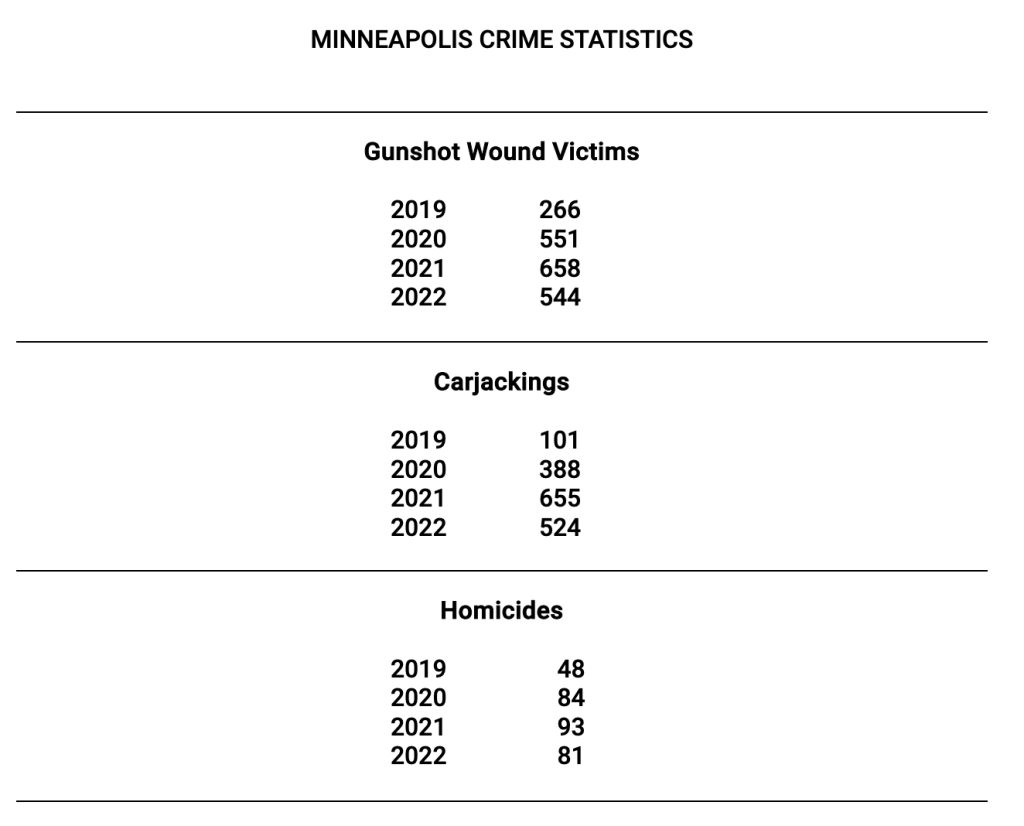
Here are some statistics about violent crime in Minneapolis since 2020, with 2019 setting the tone as a baseline year. These are some of the worst crimes, but all manners of assaults and property crimes have similarly spiked, not to mention homelessness and vagrancy. You can be sure that St. Paul (the other “Twin City”) and the surrounding suburbs are experiencing the same trend. And as anyone who has lived or spent time in a high-crime area with lax policing and prosecuting can tell you, you can definitely “feel” it in both the cities and suburbs – both the increase of crime, and the increased boldness of criminals.
Comment from an acquaintance who lives in the neighborhood:
Thanks for your article, Shane. I live in the third precinct, not far from what was the police station. While I understand the PTSD that many have from the riots in a very personal way, the people who show up at these meetings are not representative of the community. Residents like me - and there are many - don't go because the dysfunction is infuriating and the participating city council members aren't there to listen. Sad truth. There are many of us who value having the police in our community.
15 years ago today, I lost my father at age 60 to lung cancer. I had just graduated from Harvard Law School and started working at a firm in New York. My life from starting in a trailer park was about to turn around and shoot to the stars.
My father’s death made me realize that life is far too short, and I’m not here to be miserable, but to try to be happy. I left my lucrative New York law firm life to play guitar and live in poverty in New Orleans, to pursue the kind of life I want, the world be damned.
I had a lot of friends and loved my classmates and coworkers, but in a lot of ways, I never fit in with them. And outside of them, as a general rule, the world of moneyed New Yorkers was full of the most abominable people I could imagine, so while I loved my friends (and still do), I found the general culture I was in to be despicable and full of awful, shallow people I didn’t want to be around.
The day my dad died, I walked from my apartment in Long Island City, across the 59th street bridge, and up to my alma mater, Columbia, where I had the best years of my life, and where I saw my first glimpse of an intellectual life. It was a perfect, sunny day, great for reflection. My best friend Brandon was with me all day. I remember sitting in my apartment waiting for him to arrive as I stared out the window in the morning. I remember my dad’s wife calling me around 5:30 in the morning to tell me he had died. I remember calling my mom and telling her “I don’t have a dad anymore.”
That was a terrible day. And in a strange turn of life, I thought that was the culmination of bad things that could happen to me, but it was just the beginning of some of the hardest, most struggling years of my life.
Life has a way…of humbling you. I was knocked right off my high horse about who I was and where my life was going.
I don’t have a nice ending to wrap up this story, but this experience is certainly one of many that shattered my ego, humbled me, and made me see life as a journey rather than a culmination of goals or accomplishments. The universe can take everything away from you in a second, you better believe that. And more than likely you’ll find out someday, if you haven’t already. Pray that you’re strong enough to endure it, and that you learn the best lessons you can from it.


 Symposium