Of Fads And Marvel Movies

Everyone seems to have an opinion about Marvel movies these days.

The hip, artsy, film critic-y thing to say is that this is such a boooring fad, that’s long since run its course and outstayed its welcome. I know these movies aren’t for everyone, but I find that to be a bit pretentious. A genre will certainly run its course, but I think that’s more because it gradually becomes culturally irrelevant or outdated, while at the same time, the writers run out of new ways to express the genre, and interesting things to say about it. Eventually they wring out every lesson about human nature a genre has to offer.

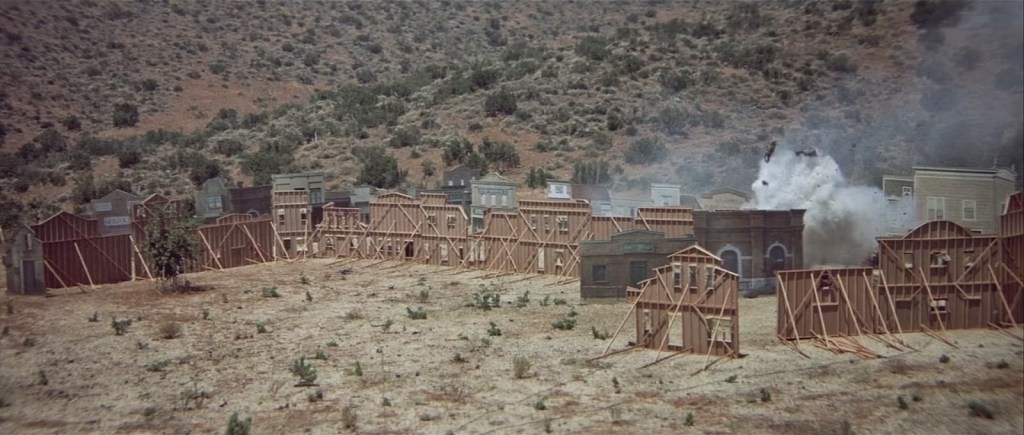
The best examples of this are westerns and gangster movies. The Old West simply lost its hold on the cultural imagination over the years, as America solidified itself as a “settled” country, and as new generations lost touch with prior generations who still had a settler mentality. Stories about exploring the country, facing danger in the unknown wild, and moving west would have been real and vibrant to people born in the 1920s or 1930s (or even earlier) who were making and watching movies in the 1950s and 60s. They would likely have recent family lore of both immigration and settlement across the country, perhaps from parents, but especially from grandparents and great-grandparents, the latter of which they would probably have much more contact with than we do today considering the age at which people married and had children. But at some point, these stories slowly faded from firsthand tellings and from the personal relevance to subsequent generations of Americans, particularly youths. And the western as a genre slowly died.

Speaking of da yutes, these same yutes who grew up on westerns went on to create and consume a new version of a previously establish genre, one with just as much action and daring as the western: gangster movies. As with westerns, at this time in America, this was a whole new world to be explored for cinema, for American culture, and for dramatic arts. These new filmmakers would completely change the gangster genre, from stories designed for cheap matinee thrills, to deeply personal examinations of human frailty, ego, and evil that were positively Greek or Shakespearean in depth and scope.

Two pieces of context are important for understanding this moment: artists were mining a new and exciting avenue of storytelling, and the mob was at that time a very real and powerful force in many parts of American society, especially in certain major cities. It was not even a recent historical artifact, as the Old West had been. It was a then-happening, currently extant reality for many people and in important parts of our society. Don’t believe me? Just ask renowned scholar and historian, Joey Diaz.

I heard the ghosts of gangsters past rattling around the city while living in New York in the 2000s. People would tell me stories about how back in the 70s every so often someone would find a body in the trunk of a car in their neighborhood in Brooklyn, or someone would point out that a famous mob hit happened at this restaurant in my neighborhood in Queens. I would hear stories of phone calls saying “We know where your kids go to school” when you ran for local office.

But, like the Old West, the mob eventually ran its course and faded from prominence in American culture and memory. To be sure, there are still job opportunities in “waste disposal” in places like New Jersey, and long-standing structures of mob corruption exist in some cities and their governments, but by and large, the modernization of society and anti-corruption efforts by people like Rudy Giuliani in the 1980s and 90s wiped out the true power of the mob as we know it and understand it. At the same time, the creative well ran dry, and there were only so many variations that even our most talented filmmakers could conjure from the types of characters and situations present in a gangster movie. In any genre, there are only so many stories you can tell.


So where do we stand inside the creative well of the modern genre of superhero movies, which to be fair really only means Marvel movies? Are we near the bottom? Have we already plunged through the ground only to not realize it yet?

I suppose I may be biased since I grew up on Marvel comics and basically learned how to read with them, but I honestly don’t see the well drying up yet, or any time soon. Here are my reasons.


First, their popularity is not attached to, and therefore not contingent upon, certain artifacts of history or culture that are tied to a particular time, that will recede as the reality of those artifacts or events fade into history. Superhero stories are not tied to reality in the same way that westerns and gangster movies were. They are not calling back historical memories or family myths, or exploring truths about social forces that exist in the real world. They are more representative of timeless stories of heroes, bravery, and morality. They call back to the most ancient stories of finding the hero within you, standing strong in the face of terrible odds, and of facing evil. In that sense, I think they are relatively timeless.

Another reason I believe the well has not yet run dry is that I am intimately familiar with a huge swath of the classic Marvel canon, and simply from a storytelling perspective, I can assure you that there is an almost limitless supply of fantastic storylines in these comics that filmmakers can draw from, both in terms of stories for one hero or team that would make excellent movies, and in terms of long-term, multi-movie crossover stories, from the Mutant Massacre to Inferno to The Age Of Apocalypse to Onslaught (and that’s just the X-Men). I never miss an opportunity to point out that I have the first comic that introduced Thanos’s quest for the Infinity Gauntlet, where a confused and helpless Silver Surfer spent the issue listening to a philosophical monologue about the moral virtue of wiping out half the life in the universe, and gave us a terrifying glimpse of what that would look like, turning the Surfer into an unwitting accomplice in a planetary genocide. I collected every issue of The Infinity Gauntlet and every crossover issue in the Marvel universe in real time, and seeing that saga come to life on screen is definitely my peak experience as a film and comics nerd.

Lest I digress too much, my point is simply that Marvel has created a bottomless well of deep and interesting stories to tell that can be translated onscreen. And that is not even to mention the stories and characters screenwriters can develop on their own from the existing universe and source material.


This actually leads me to the one thing that I think could halt the cultural success of Marvel movies, and that would be what appears to be a drastic and alarming decrease in the writing skills of today’s Hollywood writers. This is a topic that deserves its own essay from someone much more qualified to write it than me, but the gist is that the quality and depth of storytelling in Hollywood, not just at Marvel, is on a drastic decline the last few years, with no signs of abating. On the contrary, it seems to be accelerating.

There are a lot of institutional and historical reasons for it, but the main thrust seems to be that screenwriters as a talent pool are coming from an increasingly homogeneous background, with ever less life experience as a whole, and with less diverse life experiences than ever. Artists as a class, whether musicians, screenwriters, authors, or anything else, in past decades came from all manner of wild and interesting backgrounds, having lived all kinds of crazy lives before becoming full-time artists. This variety of experience meant that they brought to the table not just those experiences, but the characters, situations, and lessons from those experiences, plus just the originality that interesting life experiences allow you to draw from. It just gives you a larger, deeper canvas of creative ideas and human depth to draw from to make your art. It gives you more to create, and deeper emotions to create it with. Writers in Hollywood, like other artists, were often weirdos with weird lives, and weird stories to tell.

Today the trend is that these writers are cookie-cutter, upper middle class kids from boring yet stable homes, whose parents raised them in good neighborhoods and sent them to expensive private schools. While that may indeed be what you want for your own kids or for your accountants and lawyers, it’s definitely not what you want for your artists. It’s just not the kind of experience that leads one to have really deep or interesting insights about mankind or human nature. It’s not the kind of background that teaches you about the tragedies and triumphs of life, about the highs and lows of human emotions, about the great and terrible things people can do to each other. It’s just not a way to learn about the profound aspects of life and being a human being. To do that, you need to live some sort of life of adventure, to experience loss, tragedy, or disaster. If you’re going to write about heroes, it probably helps to have experienced fear and bravery in your life. If you’re going to write about villains, it probably helps to have met some. All this is just beyond the experience of most people writing in Hollywood today, and it shows. It shows in the shallowness of their heroes, their villains, and their stories.

If anything is going to kill Marvel, it’s going to be this.


As for me, while I still remain a huge Marvel and comic book nerd, I’m agnostic as to whether any new movie is a “superhero movie” or a “Marvel movie.” I don’t think it makes much sense to have a strong opinion about whether you want to see another one of “those kinds of movies.” I always want to see another good Marvel movie. The stories are varied enough to provide a near endless supply of compelling movies. The only question that matters is whether or not the next movie is a “good” Marvel or superhero movie. I believe we are indeed getting fewer of them, and right now I’m not sure if that trend will continue, or continue to accelerate.

I came to the conclusion years ago that the quality of a movie depends almost entirely on the writing. If Marvel makes an effort to course correct and focus on quality writing, and finding interesting, quality writers, than perhaps there is still hope for the MCU.

If not, well, you know what they say: “In Hollywood, no one can hear you scream.”


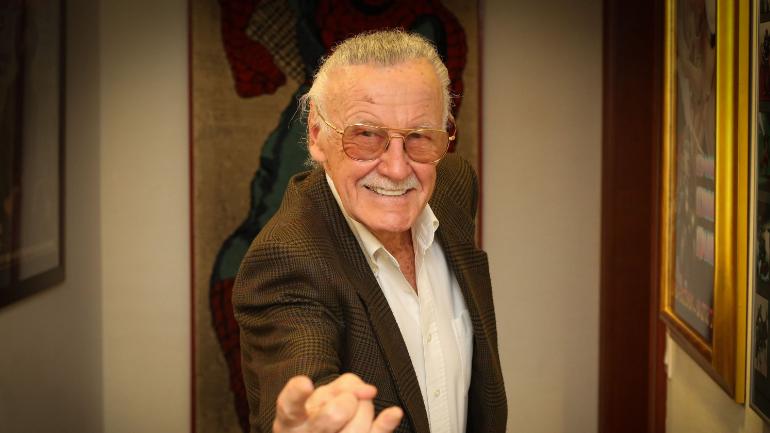
Excelsior!
Who Ya Gonna Call?

Definitely not these guys.

Angsty, Mary Sue, and Sidekick: together again

If you’re looking for a fun but scary, smart but heartfelt, dark but campy popcorn movie this month…well, you’re going to have to look elsewhere. While none of the preceding adjectives accurately describe this movie, here are a few that do:

Disjointed
Boring
Bland 
Predictable

A lot of bad movies are bad for very obvious, easy to describe reasons. Bad acting. Unlikable characters. Cheesy writing. This one is hard to describe, but I would describe its unbearable awfulness like this: the complete lack of coherent writing and narrative. That’s it. That about does it.

What does that mean? It means that literally every scene in the movie is “just some shit that happens.” *shrug*

There is absolutely no rhyme or reason to anything that happens in this movie, and if you allow yourself to think for one second why any of a dozen different things happened, it will just ruin your suspension of disbelief. It’s a movie that’s pretty obviously written as a kids’ movie with a bunch of pastiched scenes that are supposed to be “WHOA, COOL!!” moments…but can only have such an effect on children who haven’t seen more than ten movies, or any movie more sophisticated than a Disney cartoon.


Let me name just a few things about this movie that ruin the suspension of disbelief for anyone who allows their brain to work and wonder about anything for just a second or two in this movie:

1. The story doesn’t lead from one thing to the next in any sort of cohesive way whatsoever. The entire movie can be described as “This thing happened. Then another thing happened. Then something else happened. And all of these things happening is our story.” With no narrative or causal connection. One thing doesn’t lead to another, coincidentally, necessarily, or logically. The scenes in the movie do happen successively, of course, due the nature of spacetime in our universe, but they don’t lead into or cause the next one(s) in a way that flows as a narrative arc for a movie. No scene has to happen because of an event leading up to it. Each one is pretty much just its own vignette that you could cut and paste anywhere, no matter which scenes came before, or after it.

We have a scene showing Obligatory Teenage Angst and Crush, and one showing the Obligatory Lonely Nerdiness of our Mary Sue, we have another that shows the Obligatory Wit and Utility of Sidekick, etc. etc. etc., all the necessary, cliched moments of The Formula for a kick-ass kids’ adventure movie. But they are all inartfully just…there. All one at a time, stand-alone cliches, just…doing their job, I guess, of filling in the blanks of the cliches of the stories and the characters. But we don’t get any real character thought or development, or any reason that any scene should be related or connected to the next. Each scene is basically a snippet of the formula for what that scene is supposed to do, you can almost see the lines in the script “[insert exposition of x here]” in every scene.

You know how in Stranger Things every character’s story has its own unique development throughout, and then at the end you see how they all tie in together and bring the characters together, like how it all couldn’t have happened any other way due to how each thing happened to and affected each of the characters?

This is the opposite of that.

2. The main character is an absolute Mary Sue, from top to bottom, in every line of dialogue, in every action she takes. She literally knows how to do everything. Without research, training, or even a montage, she knows how to jerry-rig and restart a nuclear proton pack that her actual physicist grandfather took years of trial and error to build with a doctorate in physics by just “replacing some solenoids” or something. When she wonders out loud how he was able to put all this information and knowledge together to figure out how to solve the physics problems of the proton pack, the audience is directed to his wall with about ten different degrees on it. But she can get it working again in just one night tinkering around with some spare parts leftover in the basement.

Earlier, when the actual geologist who teaches summer school explains volcanic P waves and tectonic S waves to her (or vice-versa, who fkn cares), she’s like “DUH! I’m not STUPID.” Like, DUH. Fo’ REALS! Any kid who like, READS, knows all about stuff like this and well…everything! I mean, like any nerd, I love a smart kid in a movie, but this just exemplifies how the characters in this movie have no depth or character arcs. They don’t struggle, they don’t overcome, they don’t fear, they don’t fail, they don’t learn anything, they don’t progress. They’re just…there. Like one-dimensional set pieces.

All the characters in this movie together in the final, climactic scene

3. All the “nifty contraptions.” Oh my GOD. These are also insufferable, and also obviously pandering to children who just want to see something “AWWWEEESSSOOOMMMEEE!!” on screen without any appreciation for a half second’s thought to the practical limitations, just to try to make it logically fit into the physical universe these characters live inside, which is presumably the same as ours.

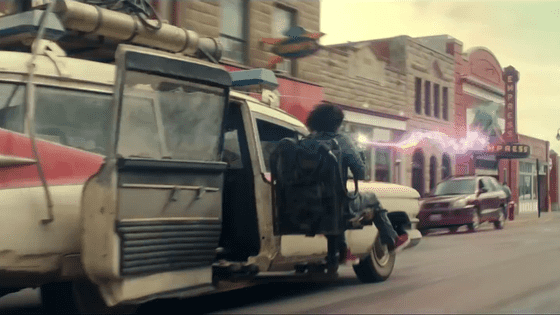
For example, this ridiculous thing:

What. The Actual Fuck. Is this.

So let me get this straight: a 15 year old who can barely drive is going 60mph+ down Main Street (we know this because we can see the odometer speeding up to increase the “tension” of the chase), with his sister sticking out of the car, chasing a ghost around…

And she lives through it.

Seriously. What is fkn going on here.

Allow me to state the obvious: that girl would be a red puddle of goo in about ten seconds when her crazily zig-zagging brother smashes her against the row of cars parked on Main Street. Her residue along those cars and in her chair would be the only reminders of her, and that ghost would spend eternity munching on whoever or whatever the hell he wanted.

This thing is literally the most useless contraption I’ve ever seen in a movie. It’s worse than any failed “dad” or “nerd” invention in any movie, worse than any “toaster helmet” ever invented…and we’re supposed to actually take this one seriously as a serious weapon in this movie. The only use that this “gunner’s seat” has in this ghost-mobile is to elicit a “WHOA! That’s AWE-SOME!” from kids ages 5-? who won’t think for a half second about what driving around with someone sticking that far out of a car would be like.

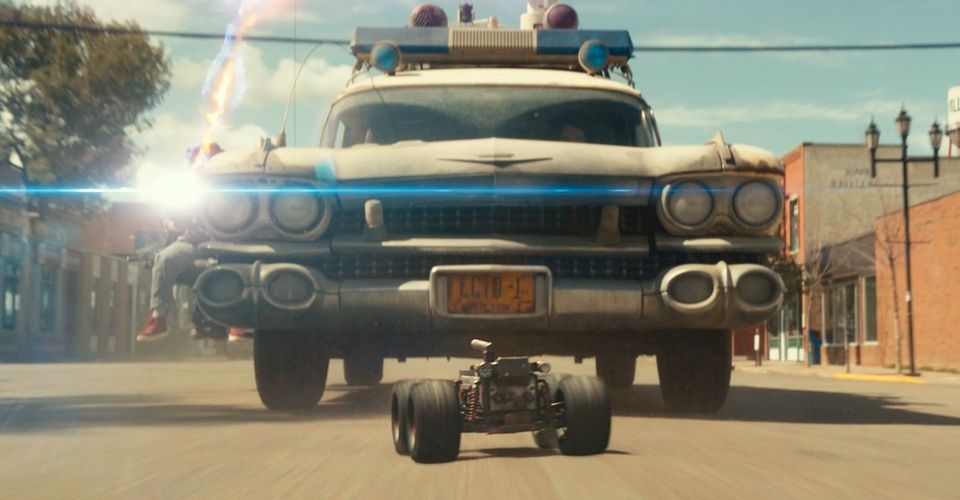
Then there’s this little fella:

Awwwww. Isn’t he CUTE!

Oh look! A cute little Wall-E type roving ghost trap! What a neat idea…a rolling, pseudo-sentient robotic contraption that makes cute little noises and needs saving. How original!

I’m just…ahhhh…I’m just…I’m sorry, my brain turned on for a second…I’m just uhhh, wondering how this cute little Wall-E ghost trap can keep up with a car going full speed at 60/70/80mph as they chase or flee a ghost. And uhhh…how Sidekick is able to keep track of it and control it with the remote at that speed, at night, while the car’s bouncing around and swerving around the road…I’m sure he can do it because he’s really smart and uhhhh…stuff.

Dammit! Stupid Brain!

4. Just generally… KIDS.

Really, the whole premise of kids doing all these things is just…too much. When the Precocious 12 Year Old and Sidekick go test out the nuclear energy beam weapon at an abandoned factory for some target practice and melt the shit out of everything in sight…too much. The fact that these children are instantly able to use these supposedly incredibly powerful devices confidently and accurately to fight demons and save the world…too much. That the kids chase and capture a ghost that SHOOTS ACTUAL BULLETS but aren’t scared, harmed, or in any real danger…TOO. FUCKING. MUCH.

Just the very conceit of making this a kids’ movie, and of kids playing around with nuclear proton packs…just imagine that everything in the original Ghostbusters, a 12 year old does. Just picture that same movie with a scrappy gang of junior high kids sleuthing out the answers to 3000 year old historical questions of gods and demons, and fighting them and an army of the undead with the power of advanced nuclear physics. Would that make sense to you? Would you be able to believe it “inside the movie?” If the Goonies weren’t Goonies but 12 year old physicists using nuclear technology to trap ghosts and fight demonic gods, would you have bought it to enjoy the movie? Somehow I doubt it.


There are so many “What’s wrong with you, don’t THINK about anything!” moments I can’t keep track of them all. Like when Mary Sue finds a random ghost trap buried in the house. Ok. So she takes it to school and her and Adult Prop #2 [Teacher] decide to open it up for funsies. Let’s take a look at a handful of questions that arise from a split second of brain activity in this one scene:

1. They have to jerry-rig power for the contraption to turn it on. Great.

EXCEPT IN THE ORIGINAL GHOSTBUSTERS ALL THE GHOSTS ARE FREED BY TURNING THE POWER OFF

Very obviously you need some kind of power source to provide whatever kind of energy field traps a ghost. But now a ghost trap doesn’t require power to work, and it can just keep them in there just…being an empty metal container…?

2. Apparently it occurs to neither Mary Sue nor the adult science teacher that the ghosts are trapped by the Ghostbusters FOR A FUCKING REASON, and decide that the best use of a ghost trap is to…free the motherfucking ghost??? WHAT???

Just…it never occurs to either Mini-Hawking Mary Sue or the, uh, adult, that ghosts might be, I dunno…dangerous?? After they nearly destroyed Manhattan, and the world, and it’s all on YouTube??

3. THE ghost, the one that just happens to be contained in that one particular trap, turns out to be a ghost that can reopen the gates of hell and re-summon the demons that threaten the earth? Just coincidentally, it’s not a fat green blob of slime, or a kinky sex ghost that hides in the fridge, it’s literally the demon-freer ghost, and Egon, who [spoiler alert] moved to this town in the middle of nowhere to save the world from the demons should they return, brings back a ghost that can open the gates and stores it five miles away from said gates of hell?? In a trap with no power?? What the hell kind of sense does that make?

Can’t. Take. Teh. Stupid.

4. Once the dangerous ghost that blows up everything around them is freed, both Mary Sue and Adult Prop #2 [Teacher]…slink the fuck off and pretend like nothing ever happened, to avoid getting caught and getting in trouble. I guess it never occurs to either of them that…there might be a…proooob-lem here…? There might be…danger here…? To them or to anyone else?

Nawwww, they just get back to being Stereotypically Morose Child Prop and Horny Adult Hilariously Trying To Bang Mom again. Because: Formula.

And this is just one scene.


I could go on. I could wonder why Angsty, Crushing Teenager goes from being dumbstruck, picked on, and alienated, to partying with the (appropriately diverse) cool kids from work, literally from one scene to the next, and then suddenly finding himself in a romantic moment of connection with his crush despite the fact she supposedly finds him pathetic and supposedly has a boyfriend (who we only hear mentioned once). Again, there is no arc, there is no series of events, there is just: kid has crush, crush laughs at kid, kid and crush are suddenly close.

I could wonder why Sidekick and Mary Sue, when they start thinking something is going on and looking around the house for clues, out of the 500 books lying around the house, find the exact right book and the exact right chapter that mentions the undead bad guys they have to defeat in our story. Again, no exposition, no story, no events no build up, no tension…let’s just pick up a book at random and discuss the backstory of the demon that threatens the town. It’s not even a tense, anticipatory scene, it’s just like a fun scene where Diverse Sidekick practically looks at the camera to explain the exposition to the audience.

I could wonder, when supernatural events start happening, why they happen when and where they do. In the original Ghostbusters, there is a very specific reason that there was a Stay Puffed Marshmallow Man. You remember what it was, don’t you?

That was a statement, not a question.

Here we got a bunch of cute Mini-Stay Puffeds…becaaauuuuse….sequel? There is literally not a possible, plausible, or potential reason these things show up in the movie at all, let alone precisely when and where they do, amusing and affecting one of the main characters, who doesn’t even seem too shocked by these fucking creatures even existing. Is this more where I’m supposed to fill in the blanks myself? With…nostalgia, I guess? Drugs? Certainly not with plot, reason, or backstory, since none is presumed nor implied.


In the end, this is just a movie with no story. It’s like a (shitty) Disney them park ride of your favorite movie, a mechanical pastiche of moments that are supposed to trigger nostalgia and for which you’re supposed to fill in the emotional blanks yourself, I guess. A collection of disparate, unconnected, nostalgia-inducing moments that are totally contrived and have nothing to do with each other. Every aspect of what passes for a story here is just a coloring book of a Hollywood cliche, with no heart or explanation, and no thread connecting one character or moment to the next. This movie wasn’t a story, it was just a series of individual scenes that you only understand because you’ve seen the original a dozen times.

If you’re looking for a fun and spooky kids’ adventure movie, I’d suggest rewatching Stranger Things, or any of the 80s movies that inspired it, rather than a cut & paste random mashup of the formulas they inspired. This movie is more like seeing the Chuck E. Cheese robots performing without their masks, so that you can see the gears and levers underneath, their faces all a-smiling, yet also grimacing death. When I watch a movie, I personally like to avoid seeing the levers, so that I myself don’t feel like one of those gears or one of those robots, being manipulated by the mere mechanics of it all.

A fan of this movie on his way to tell friends to watch it.

Movie Review: The Predator

I donโ€™t know about you, but when I see a Predator movie, Iโ€™m in it for a moving message about climate change.

Anyone…?

Anyone…?

Well, that’s what you get if you go see the new Predator movie. Now there’s not really much to write as a review for a movie like this…you know what you’re getting into and what you’re signing up for, you just hope that they give you what you’re paying for in a fun, interesting, and possibly compelling manner. The original Predator movie was definitely scary and intense. I haven’t re-watched it recently, but I have re-watched it several times, and it has held up each time. It’s the perfect balance of camp, action, and suspense, as well as a splendid primary source for 80s one-liners. Needless to say, I’m a big fan.

All I wanted or expected from this movie was a few mindless action scenes and some unoriginal but fun kick-assery. Unfortunately the action was more mindless and the kick-assery was even less original and fun than I had hoped (as opposed to, say, the last two Mission: Impossible movies, which I highly recommend for compelling action). But the Big Annoying Thing That I Can’t Ignore had to show its ugly face again: blatant political messaging from some more “very brave” Hollywood writers. It’s not spoiling anything to say that a major plot point revolves around the Predators coming to earth because of climate change. It’s even painfully and obviously belabored for the better part of a minute as one by one the characters awaken to the “totally obvious” realization that we only have a generation or two left of a habitable earth, and that the inescapable Predator Logic is drawing them here to replace us once our time is up.

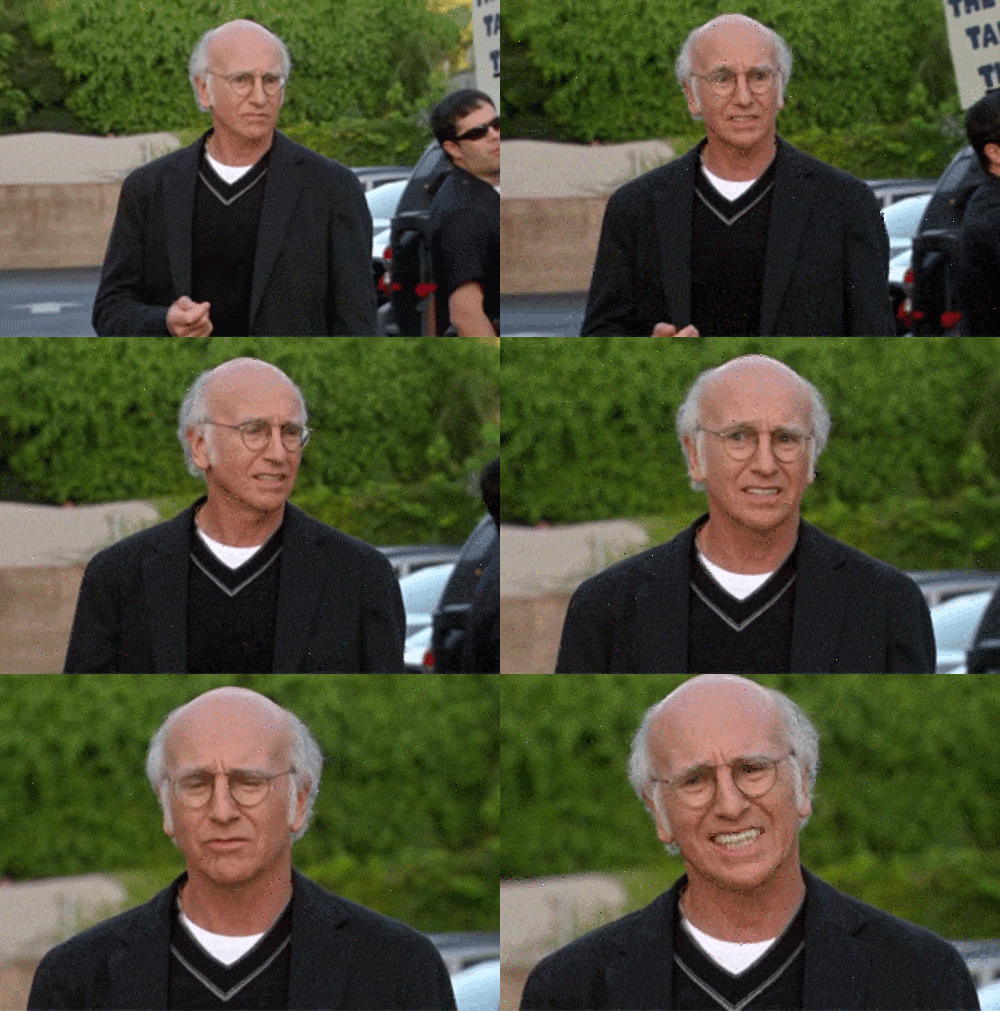
How I felt when the plot twist came

I’m sorry, but can I just go to one f’ing movie without getting “messaged” hard right in my face?

*insert your own imaginary gif for this*

*sigh*

I guess not. It seems now like nearly every time I go to the movies I’m going have some moral authority in Hollywood telling me what and how to think. I don’t know if it’s worse when it’s subtle or when it’s overt, but I’m pretty sure most people aren’t noticing either way, and are just absorbing it all as “patently true” social commentary. As I’ve stated before, the nonstop 24/7 political messaging in nearly all television and film is a propaganda machine/weapon that fascist regimes of the 20th century could only dream of. And no, any one instance is not that big of a deal, nor too much of a cause for outrage. It’s the cumulative effect of hundreds of these message a year and thousands of them over the course of years, subliminally sneaking is as “normal” and “RightThink.” If this doesn’t bother you because you’re liberal and you believe it is indeed the right way to think, and that people need to be told as much, just reverse the polarity of the messaging and think about how you’d view, for example, the nationalistic or imperialistic or anti-communist/anti-liberal or pro-war social messaging and conditioning of the early and mid 20th century being broadcast in almost every sort of media that people consume, all day, every day.

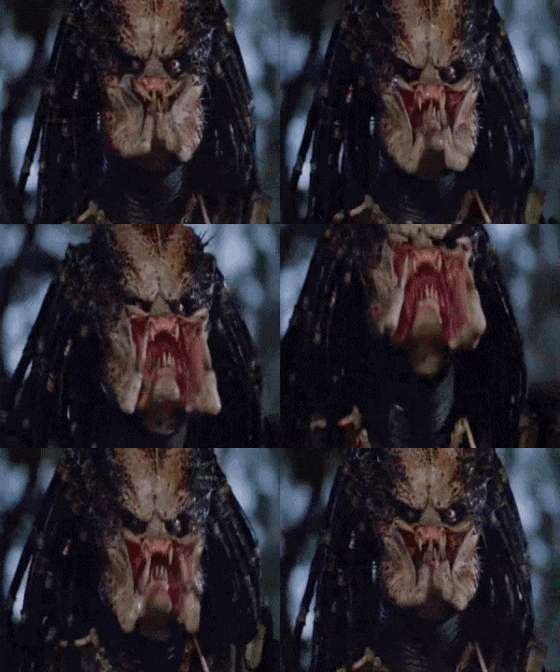
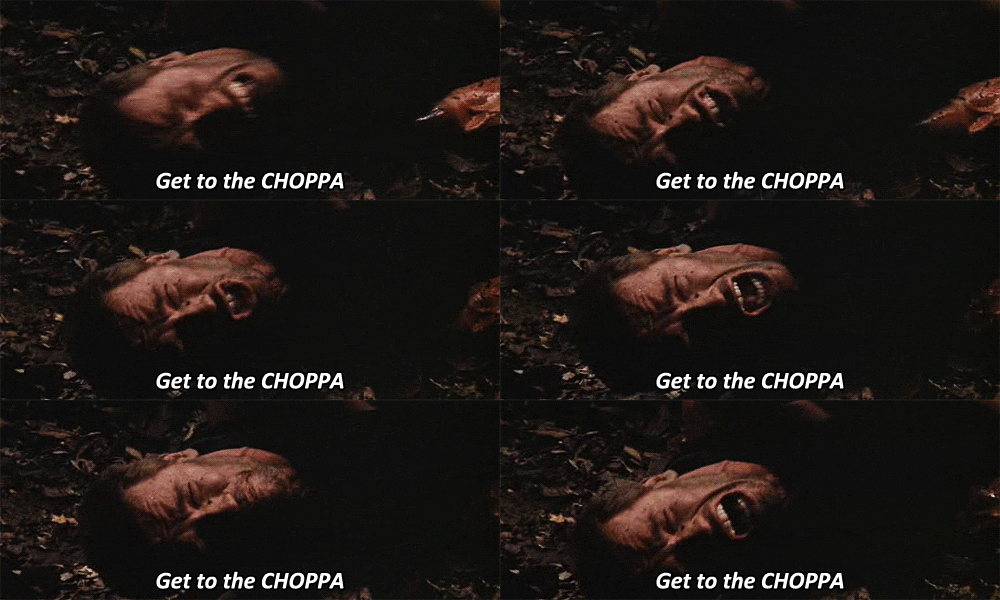
Alright, this otherwise awful movie has already taken up too many words and too much time. But as movies are a passion of mine, I wanted to take the time to make a note of this for the record, to add this entry to the ledger of obvious Hollywood brainwashing. The movie is regrettably not worth seeing on its merits apart from this (and I would recommend it if it was), so for any 80s/Ahnald fans who may be looking forward to a fun, campy stroll down Memory Lane, I’ll just say:

Black Panther: The Politics

So I’m a little late in posting something about this, the movie has been out for awhile now. But on the other hand, maybe that means that most people who wanted to see it in the theater have had a chance to, and so there’s less chance of me spoiling something for a movie fan. If you have not seen the movie, I suggest reading this after you have, although I actually am not going to reveal any major plot points or spoilers, except one that’s fairly obvious to anyone who’s been awake in the last two years watching electoral politics.

As someone whose politics lean sliiiiightly to the right of Hollywood, the blatant preaching and overt, ham-fisted messaging present in what seems to be an ever-increasing number of movies and television shows is a major nuisance to my viewing pleasure, and often detracts greatly from my ability to enjoy watching. It’s hard to lose yourself in the story and suspend disbelief when you can see a blatant, staunchly partisan message coming across in the dialogue or action like a banner behind an airplane, and always from the same point of view, of course. It doesn’t make it less odious to realize that most others who view it will not even notice, quite the opposite. It’s only extra aggravating to know that most of the viewing public will not consciously register it, and rather mentally bathe in it unnoticed, as a sort of background radiation of the social and political universe, the unspoken, unremarkable, universal facts, if you will. Which, of course, makes entertainment propaganda and indoctrination the most insidious of all. That propaganda works best which is not known as propaganda at all. At least in the 20th century, the propaganda had the “honor” and “transparency” of being out in the open, and publicly advertised. Now we pay lip service to opposing it, while it runs under, through, and out of literally the entirety of all entertainment we consume.

And quite quickly, just in case anyone’s wondering, no, I’m not wishing for the remedy of overt or covert political propaganda from “the other side” to balance it out. Frankly, I’m not even wishing it out of existence entirely, I’m not that much of a magical thinker. I just wish it was rare rather than common, good-humored rather than hissing, subtle rather than transparent, and maybe just once in a while only moderately to the left rather than from the dankest corners of the Social Justice Warrior cellar.

All that being said, I have to admit that Black Panther, despite its very existence having perhaps the most portentous and loaded political undertone of any movie I can remember, fulfills the requirements of my last sentence, if indeed political messagingย must exist in a movie at all. It is rare, mild, good-humored, and subtle. In fact, the quiet politics of the movie only pop up all of three times that I can count. The first and most transparent time is when our hero is chatting with a close friend, and they are discussing whether or not to reveal the true nature of Wakanda’s existence to the world, which would necessarily entail putting themselves on the radar of some assumedly poorer and less developed African neighbors. King T’Challa’s friend warns him that if they do so, they will be sure to have refugees soon arriving at their door, and “Refugees bring their problems with them.” Before he even finished the sentence, I knew that this character was going to turn out to be a bad guy. And when a plot point like this is so easy to discern from one line of dialogue, you start to get an idea of how pervasive and blatant Hollywood’s messaging problem is.

But, this scene and dialogue flowed nicely and evenly after that line, so I was only happy that they didn’t belabor the point, only a trite clichรฉ that “We must decide what kind of country we are to become.” Likewise, when the king’s love interest, who from the start has probably the highest moral position of the movie and is most likely the character that is supposed to be the vessel for the audience, says that indeed they must decide what kind of country they are to be, and they must be an open country that welcomes refugees, you know that she is the moral voice of the filmmakers and the moral anchor of the story. But again, the dialogue, while no Shakespeare, is good-humored enough and flows easily enough past this point that it does not grate much, if at all. It feels more like “Ok ok, I know you had to get it in there, whatever, not even mad.”

Finally, there is a scene at the end where the King is addressing the United Nations, and says that rather than continue their traditional isolationism, they want to open themselves up to the world. I cringed a little when an old white man says “But King T’Challa, what does Wakanda have to offer the world?”, because that’s a little obvious, but it’s not, how shall I say, more coarse or blunt than this boilerplate superhero movie is anyways.

I should step back and say the aggravation of political messaging in a movie seems to have an inverse relationship to the quality of the movie itself. In a movie that is really high quality, even of the superhero genre, moments like this might detract from otherwise high-level, subtle, even exquisite writing. Think about moments like this if they happened in The Dark Knight, or the original Avengers movie. It would have been jarring and taken me out of a movie that I was lost in. Here, I never felt elevated beyond the popcorn-level experience, so a handful of political messages of a subtlety on par with the rest of the movie is not very shocking, nor is it ruining what otherwise could have been a delicate artistic experience. That’s not to disparage this movie as a bad movie, but it’s not a great movie either, not even a great superhero movie. So there’s less to lose or spoil with these little pieces of the writers’ politics.

There is another reason I was pleasantly relieved at the manner in which the politics of this movie were displayed, and I’m not sure if it’s an objective measure, or simply a barometer of low expectations and how far we have sunk. But to me, the politics of this movie were, astoundingly, fairly moderately liberal, and better yet, fairly timeless. Should I confess multiple sighs of relief that this movie, near as I can tell, took no direct jabs at our current president, in any manner, on any topic? Is it objectively good, or simply that I expect so little, that there were no messages related to any of the polarizing identity politics topics that have been the focus of moral panic over the last few years, regarding race, gender, or trans-anythingism? Is it right to almost feel like I should applaud Hollywood movie writers, and, dare I say it, black Hollywood movie writers, producers and directors, for not throwing some dreary, obvious stones at Donald Trump or firing some quivers from the bag of racial identity politics arrows that have been filled to capacity recently?

Is there some kind of award for that? Maybe there should be…

razzie-award1

To restate it, I felt like the relatively mild and unobtrusive political messages in this movie could have, and very likely would have, existed and had meaning ten or twenty years ago, or twenty years in the future. They felt like very universal campfire feel-good sentiments that could be part of any movie Hollywood might have ever made. Again, context matters, and considering the political baggage around the very fact that this movie happened, not even to mention the time it happened in, I have to say I’m genuinely very, very pleasantly surprised with how the creators of this movie handled the politics contained in the story, and honestly very impressed that they did not succumb to inserting obvious, boring political messages that would no doubt have been hailed and huzzahed as “brave” and “resistance” to…..whatever.

So frankly I think that this speaks very highly of their artistic integrity, if not their business sense. I suppose there is some cynical possibility that they were chomping at the bit to do just that, but refrained for fear of alienating potential audience members, but I think this would have just as likely rallied those inclined to see this movie anyways, certainly the critics, and certainly would have given them some free media buzz and soundbite attention. And then there’s the fact that they did insert some politics anyways, so if there were cynical business motives involved, you would think they’d have the sense to scrub those as well. No, my sense is they handled this just the way they wanted to, and all-in-all, with the entirety of the context considered, including the social and creative world they live in, I think they handled it pretty impressively and with an admirable amount of restraint from where you can be virtually certain their political views lie.

So why do I write this? Because I think art matters, both when it’s political and when it is not, both when it’s intentionally or overtly political, and when it’s political only as an unavoidable consequence of context, such as the first virtually all-black blockbuster popcorn movie. (Isn’t it funny, by the way, that it took us ten years after the first black president to get such a movie? Perhaps a subject for another essay…) Regardless, I view art as meaningful and essential to the human condition (Rubinstein plays Chopin in the background as I write this), and how it gets created and what it conveys, overtly and indirectly, matters. It is important whether overt politics has taken over the fictional getaways of our storytelling, and whether and when it has not, or has not much. Thankfully, this movie, as well as the other comparable popcorn movie Wonder Woman, handled this pressure well, handled it with grace, and did not succumb to easy virtue and cheap praise for cheap shots in the midst of what is, after all, supposed to be entertainment. And I applaud all involved for that. I can only pray they manage to keep it up and resist the temptation to “be brave” and “resist” by scoring easy applause and points in their creations going forward.

But so far, as of now, we can say: so far so good.

Black Panther: Movie Review

As those who know me personally are aware, I am mixed race, half white and half black. There are some ways in which this matters a lot and brings some important meaning to who I am, how I feel, and to my views in life, and there are some ways in which this means nothing. My feelings about this movie are a mixture of both.

Another aspect of my identity and personality, probably far more significant to me than my race, is that I am a lifelong comic book geek, specifically a Marvel fan. As such, I have a heightened interest in and affection for Marvel movies and the Marvel universe, and a pretty solid understanding of the stories, characters, and themes of the comics on which these movies are based.

So for me, this movie connects two important aspects of my life in very exciting ways, and every since it was announced, I’ve been cautiously optimistic and hopeful that this movie would deliver.

So to get started, let me say this up front: this movie delivers.

It is exciting.

It is dramatic.

It is action-packed.

The characters are interesting and compelling.

And most of all: it’s justย fun, which really should be the goal of any comic book movie.

The central theme of the movie is the internal struggle of the Black Panther, who is the king of the fictional Wakanda, over what kind of king to be, and what kind of kingdom he wants his homeland to be. It’s the ancient theme of the struggle to rule, both internally and externally. These themes are recognizable from Shakespeare and Machiavelli to Braveheart and Troy: what it means to be a just or effective ruler (can you be both?), what it takes to protect your people, how to defend your power within your kingdom, and the struggle between being a philosopher and a king. For a philosopher’s domain is Truth, and a king’s domain is Power. A philosopher can wax poetic about abstract, universal principles, while a king has the much more earthly concern with the welfare of his people, how they can sustain themselves, how they can perpetuate their culture, and how he can prevent or repel foreign invasion. The movie explores these themes on various levels, and it makes the viewer understand that these are not simple problems with easy solutions. It explores both king T’Challa’s internal struggles and his struggles with his enemies, within the kingdom and without.

But let’s not get too serious here. It is, after all, a comic book movie. While it does explore the themes I’ve mentioned, it is far more a comic book movie than a philosophical treatment of leadership. The characters are all fun, cool, and kick a lot of you-know-what. One thing that mildly and surprisingly pleased me was the scope of the powerful female characters in the movie. As a friend told me today, “I was expecting the movie to have strong black characters and to feel a sense of black empowerment, but I didn’t expect it to be so full of awesome female characters and have so much female empowerment!” And this is true. In fact, while I’ve only seen the movie one time, my sense is that there are actually more important female characters than male characters in this movie. And they are really cool characters that are fun to watch.

Overall, this movie really makes the grade, and I have to highly recommend that everyone watch it. There is a fair amount of politics and fanfare surrounding this movie, but I have to say it’s been handled pretty well and much more tastefully than I would have expected. I think there’s really no way to get around it, it is SUPER cool to see a movie comprised almost exclusively of black characters, and, but here’s the important part: a movie that’s NOT “about” black people, “about” black culture, “about” black struggles or history, or “about” black families and communities. It’s just a plain old super hero movie, about a hero who just *happens* to be black, in a kingdom that just *happens* to be in Africa. It’s just a story folks, it’s not about black people, and it’s not about being black. It’s just a cool, kick-ass story about heroes, villains, sword fights, cool hair, cool cars, and cool costumes. The black people in this movie aren’t one-dimensional. The hero is black. The villain is black, and he’s an evil S.O.B. (while also having a nuanced, understandable back story, “yay Marvel!”). The morally ambiguous spoiler is black. The people who support the hero are black. The people who betray the hero are black. Black people are good, bad, and everything in between in this movie. And that’s important. If a movie is going to be “for” black people in the marketplace, it has to represent black people asย people, with every greatness, evil, virtue, and flaw of people. And this movie does that.

I was going to write a bit at the end about the politics contained in the movie, but I think I’ve said enough here about whether I recommend the movie or not, and that I should save that for a separate post.

The only thing that needs be said here is: go see Black Panther, as soon as you can!