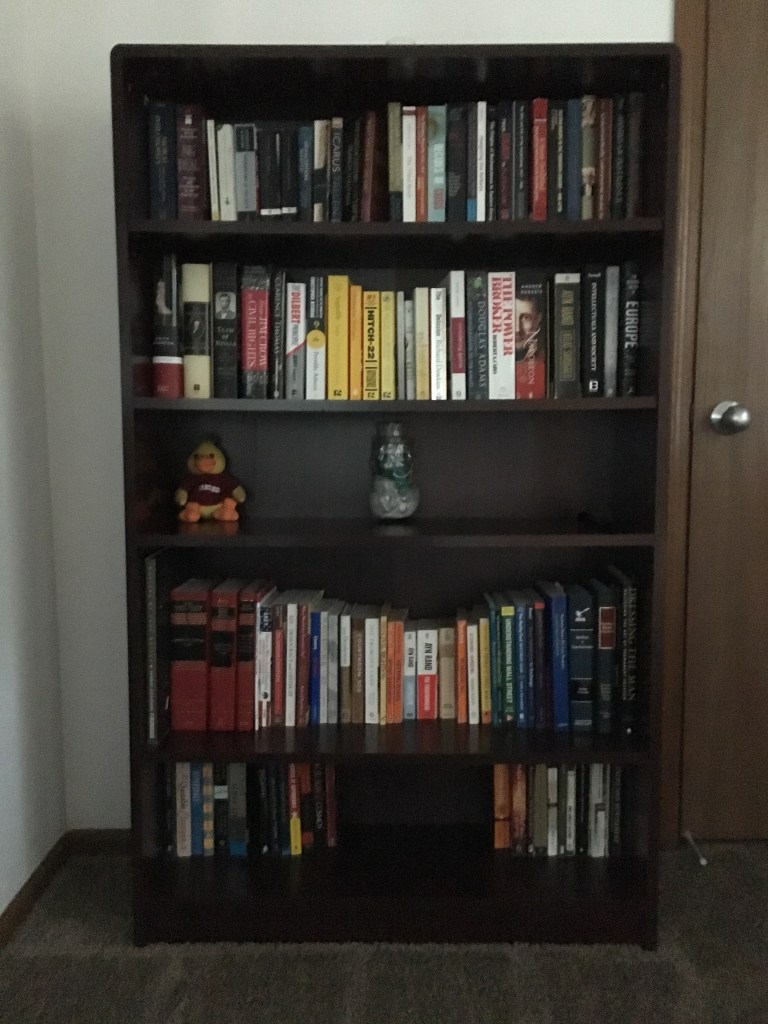
Here’s a little optimism to start your weekend

A place for thinkers
Here’s a little optimism to start your weekend
When I was a young socialist (yes, you read that right), I had a lot of opinions about what people and society should do with their money. But I didn’t know a single thing about actual economics. No, not one thing. I was completely ignorant even that I should know things about economics, I was deep into the realm of Rumsfeldian “unknown unknowns.” I didn’t know what I didn’t know, and this meant that there was no way for me to learn on my own and teach myself to a better understanding. I was ignorant of my ignorance, which I now know is itself a well-understood and studied phenomenon: part of the condition of being ignorant is that you don’t know you’re ignorant. It’s kind like how part of being crazy is that you don’t know you’re crazy.
There’s even a fancy name for it:

This is a topic worthy of discussion in its own right, but I just want to mention it to paint a picture of where I myself have been regarding the topic of economics. This abstract basically describes my level of economic understanding in my 20s:
People tend to hold overly favorable views of their abilities in many social and intellectual domains. The authors suggest that this overestimation occurs, in part, because people who are unskilled in these domains suffer a dual burden: Not only do these people reach erroneous conclusions and make unfortunate choices, but their incompetence robs them of the metacognitive ability to realize it. Across 4 studies, the authors found that participants scoring in the bottom quartile on tests of humor, grammar, and logic grossly overestimated their test performance and ability. Although their test scores put them in the 12th percentile, they estimated themselves to be in the 62nd. Several analyses linked this miscalibration to deficits in metacognitive skill, or the capacity to distinguish accuracy from error. Paradoxically, improving the skills of participants, and thus increasing their metacognitive competence, helped them recognize the limitations of their abilities.
In essence, we argue that the skills that engender competence in a particular domain are often the very same skills necessary to evaluate competence in that domain—one’s own or anyone else’s. Because of this, incompetent individuals lack what cognitive psychologists variously term metacognition, metamemory, metacomprehension, or self-monitoring skills. These terms refer to the ability to know how well one is performing, when one is likely to be accurate in judgment, and when one is likely to be in error.
For example, consider the ability to write grammatical English. The skills that enable one to construct a grammatical sentence are the same skills necessary to recognize a grammatical sentence, and thus are the same skills necessary to determine if a grammatical mistake has been made. In short, the same knowledge that underlies the ability to produce correct judgment is also the knowledge that underlies the ability to recognize correct judgment. To lack the former is to be deficient in the latter.
If you would like to know more about the Dunning-Kruger Effect, you can read the Wikipedia article here, view and download the full paper here, or read it online in html here.
So there I was, Dunning-Krugered as hell about economics. So what happened? What always happens with me: I started arguing with people. I took my DK’d self with my DK’d ideas, and brought them all cocky and manly like to other nerds and wonks, and got my ass severely kicked and handed to me over, and over, and over again, in debate after debate. I literally cannot count the number of debates I lost, and how many times I didn’t just lose a debate, but basically got woodshedded like a red-headed stepchild.
[This was in my mid-20s, after a five year stint in the army, while an undergraduate at Columbia University]
But two things have saved me in life from having this sort of thing destroy me and ruin my self-confidence: one, that I can take a loss, and two, that I can learn from one. I would walk home from an argument outside of class or outside a bar, swearing and muttering to myself all the way home (on the inside, I hope). Mostly for being so stupid and so wrong, and occasionally, for being so arrogant. And each time, mad as I was, I was even more grateful, for having been so violently and suddenly disabused of such erroneous ideas. As Sam Harris once said: I don’t want to believe a wrong thing for one minute longer than I have to. So I welcome intellectual challenges and people who can teach me something, or better yet, correct any wrong ideas I currently have.
Of course, as time went on, I sought to educate myself. Once I realized this was an intellectual weakness of mine, I read an uncountable number of articles on economics, sought out people who knew more than me (now to ask questions, rather than debate), and read a few foundational econ books. I realized through the course of these conversations that while I considered myself a policy wonk and a politics nerd, I was lacking a fundamental pillar of understanding these issues: that of basic economics. I realized that I was functionally illiterate in one of the core areas necessary to understanding our world, and to having an educated opinion on political topics. It was one of the most humbling intellectual realizations of my life, and maybe the first real moment and topic where I found myself sitting in silence with an awareness of my own profound ignorance of something so obviously important, if you actually knew anything about the world.
The reason I’m writing this essay is that I have come to realize that my own ignorance, while shameful and appalling, is not unique. In fact, I think it is the norm. Now just like I recently stated that I’m no mathematical genius, I’m also no economics genius. I’m not an economist, even by hobby, let alone trade. I’m no expert on economics or economic theories, even a lay expert or hobbyist. But here’s what I’ve come to fear/realize: I simply know basic economics very well, and that means I know more than 95% of people I meet. And I don’t mean 95% of people in the mountains of Arkansas. I mean 95% of college educated people with otherwise sophisticated and nuanced understandings of the world. I mean that just as I made it through high school and college without a single day of economics education, so does pretty much everyone else. Literally everything I’ve learned about economics has been self-taught. And in that regard, I think “the system,” whatever that means, our education system, society writ large, whatever, has failed me, and continues to fail current and future generations of Americans. I mean that you literally cannot have a reasonably educated and sophisticated understanding of politics and society without an understanding of basic economics. This is a disservice to all of us as a general citizenry, when most of our educated, voting adults pretty much know nothing about economic fundamentals.
And it’s not just politics. It’s personal. Understanding basic economic concepts has drastically improved my thinking and decision making in exponential, innumerable ways. I literally cannot imagine my life, thinking about politics, analyzing situations, or making decisions without knowing about things like opportunity cost, marginal utility, economies of scale, or comparative advantage. I cannot imagine how I could effectively analyze or understand pretty much anything about the world without these conceptual tools. Economics is in a very real sense an exercise in pure logical thinking. It’s about as close as you can get without using Actual Math or formal logic. That’s because it requires logical formulations and connections to make sense. It requires definitions and axioms (for example supply and demand and their effect on each other). It requires clear formulations and connections that can be reduced to formal logic terms such as “If A, then B” or “If A, then not B” (ceteris paribus reasoning, for example). You have to logically connect concepts and conditions to understand how they work together. It’s not a matter of interpretation, there is a right and wrong answer, and the strength of your logic determines your ability to find the right one, or to be as accurate as possible based on the available data. This is the beauty, the elegance, and the power of economic thinking.
A couple of examples from one of my favorite authors:
1. That which is seen, and that which is unseen
A very common economic fallacy, as well as general human cognitive error, is to evaluate a choice or an action by a very obvious (usually positive) effect, but to ignore a less obvious (usually negative) effect, which may precisely offset or even be greater than the apparent effect/benefit. Here’s an example: a trade policy, tax policy, subsidy, or other government action that benefits one group of people, let’s say farmers. Giving a generous tax break or subsidy or trade protection to this one group, on its face, at first blush, seems like a great thing…look at all the farmers we’re helping. Look how much better off they are. Isn’t it wonderful? How can you be against it? Do you hate farmers…?
What most people don’t see, because they’re not used to economic thinking, is that the benefits are obvious because they’re focused on a (relatively) small, discreet, graspable group of people, but the costs are distributed to everyone else in society. We may enact a policy that will help farmers, but the cost of that policy is that the cost of their goods rises for everyone else, or that the rest of us pay for their subsidies in other ways, perhaps in higher taxes. This is a tradeoff, and perhaps it is one we want to make, but most people are not even aware that we are making it, and therefore the tradeoff is not debated or factored in when crafting this policy. And we certainly ought to discuss if we do in fact want to make any of the necessary tradeoffs for any particular policy.
Again, benefits are focused, but costs are disbursed. We have to realize this whenever we craft any sort of economic policy. Everything has to be paid for. Yes, everything. Literally, everything. And we rarely ask what the costs are for our particular pet projects, and are typically discouraged from doing so if we try to bring it up. This actually raises another point, that everything has a cost, and we can’t just do everything that we’d like or that seems like a good idea, because we can’t afford it. That’s its own issue, but related to this one. If more people thought about the tradeoffs and costs involved in any particular policy, I believe most people would be a lot more conservative in their pet projects designed to help this or that particular group.
This is a long essay discussing this topic, but you can understand the principle well enough just reading the introduction and Part I.
In the department of economy, an act, a habit, an institution, a law, gives birth not only to an effect, but to a series of effects. Of these effects, the first only is immediate; it manifests itself simultaneously with its cause — it is seen. The others unfold in succession — they are not seen: it is well for us, if they are foreseen. Between a good and a bad economist this constitutes the whole difference — the one takes account of the visible effect; the other takes account both of the effects which are seen, and also of those which it is necessary to foresee. Now this difference is enormous, for it almost always happens that when the immediate consequence is favourable, the ultimate consequences are fatal, and the converse. Hence it follows that the bad economist pursues a small present good, which will be followed by a great evil to come, while the true economist pursues a great good to come — at the risk of a small present evil.
In fact, it is the same in the science of health, arts, and in that of morals. It often happens, that the sweeter the first fruit of a habit is, the more bitter are the consequences. Take, for example, debauchery, idleness, prodigality. When, therefore, a man absorbed in the effect which is seen has not yet learned to discern those which are not seen, he gives way to fatal habits, not only by inclination, but by calculation.
This explains the fatally grievous condition of mankind. Ignorance surrounds its cradle: then its actions are determined by their first consequences, the only ones which, in its first stage, it can see. It is only in the long run that it learns to take account of the others. It has to learn this lesson from two very different masters — experience and foresight. Experience teaches effectually, but brutally. It makes us acquainted with all the effects of an action, by causing us to feel them; and we cannot fail to finish by knowing that fire burns, if we have burned ourselves. For this rough teacher, I should like, if possible, to substitute a more gentle one. I mean Foresight. For this purpose I shall examine the consequences of certain economical phenomena, by placing in opposition to each other those which are seen, and those which are not seen.
2. Comparative advantage
One thing you will find in common with all professional and lay economists is a universal disapproval of trade barriers, tariffs, and protectionism. This is not because they don’t value the farmers, merchants, and tradesmen of their own country, or that they do not have proper patriotic feelings. It is because they understand basic and universal economic maxims. One such maxim is that every country, society, and culture has its own unique advantages for producing goods, and we all benefit when everyone uses them as freely and as maximally as possible. Conceptually, there is a bit of “what is seen and unseen” in this as well, but has the additional condition of specific advantages residing in each discreet group of people.
A very easy example of this is the environmental conditions for growing natural produce. It is probably possible to grow oranges, for example, in Minnesota. You could grow them for a few months in the summer, and conceivably build indoor facilities to grow them indoors year-round. But though such a thing is economically possible, it is not wise. We could do it if we tried, but it is obviously much more advantageous to everyone if oranges are grown in a climate naturally suited to their thriving, all year long, say in Florida.
As The Man Himself put it:
Labor and Nature collaborate in varying proportions, depending upon the country and the climate, in the production of a commodity. The part that Nature contributes is always free of charge; it is the part contributed by human labor that constitutes value and is paid for.
If an orange from Lisbon sells for half the price of an orange from Paris, it is because the natural heat of the sun, which is, of course, free of charge, does for the former what the latter owes to artificial heating, which necessarily has to be paid for in the market.
Thus, when an orange reaches us from Portugal, one can say that it is given to us half free of charge, or, in other words, at half price as compared with those from Paris.
Now, it is precisely on the basis of its being semigratuitous (pardon the word) that you maintain it should be barred. You ask: “How can French labor withstand the competition of foreign labor when the former has to do all the work, whereas the latter has to do only half, the sun taking care of the rest?” But if the fact that a product is half free of charge leads you to exclude it from competition, how can its being totally free of charge induce you to admit it into competition?
To take another example: When a product—coal, iron, wheat, or textiles—comes to us from abroad, and when we can acquire it for less labor than if we produced it ourselves, the difference is a gratuitous gift that is conferred upon us. The size of this gift is proportionate to the extent of this difference. It is a quarter, a half, or three-quarters of the value of the product if the foreigner asks of us only three-quarters, one-half, or one-quarter as high a price. It is as complete as it can be when the donor, like the sun in providing us with light, asks nothing from us. The question, and we pose it formally, is whether what you desire for France is the benefit of consumption free of charge or the alleged advantages of onerous production. Make your choice, but be logical; for as long as you ban, as you do, foreign coal, iron, wheat, and textiles, in proportion as their price approaches zero, how inconsistent it would be to admit the light of the sun, whose price is zero all day long!
Simply put, every society and region has its own economic advantages, whether it be advantages of nature, a particularly developed and sophisticated industry, a highly skilled workforce (generally or in specific areas), cheap labor, the list is endless. When we do not restrict trade between all of these splendidly diverse regions and people, we all benefit, by everything being cheaper and more readily available in greater quantities than would be if we institute tariffs or other trade barriers to protect our own “hard working, indigenous” whatevers. Protectionism is, economically speaking, always bad, because it raises the cost and limits the supply of everything it touches. Again, this is not advanced, mathematical economics, accessibly only to calculus geeks. This is basic, common sense knowledge that allows us to maximize everyone’s economic and material well-being, and saves us from costly errors harming not just society in general, but the very people we seek to protect with trade barriers.
As I said, I’m no economic genius. I couldn’t calculate a supply and demand curve to save my life. But I know what one looks like, and have seen plenty of them. I can’t punch up a formula to calculate producer surplus or consumer surplus, but I know what they are, conceptually, and this basic economic knowledge allows me to rationally analyze the world around me, political decisions, and economic decisions on both a personal level and a societal level. I don’t consider my economic understanding to be advanced, but it is still greater than almost everyone I encounter when I discuss economic subjects. I think my grasp of economics is the bare bones baseline required to understand our world, and I think it’s a crime that we seem not to care about it as a society, and that we completely neglect it in the education of our young people. To have a functional, rational society, everyone should have at least a basic understanding of democratic and republican principles, our constitutional history and framework, and the core economic principles that dictate the success, failure, and cost of our political policies.
If I could snap my fingers and change one thing about our society, it would be to require at least two years of basic economics in high school and one in college (non-math intensive for the math-challenged), as a pillar of being an educated citizen with an ability to fulfill your basic civic duty. Until we make basic economic literacy a pillar of our education system and civic culture, we are likely to continue the economic and political deterioration of the last few years, and eventually, the consequences are going to catch up to us, in dramatic and painful fashion.
“I was surprised to find myself so much fuller of faults than I had imagined, but I had the satisfaction of seeing them diminish”
Ben Franklin
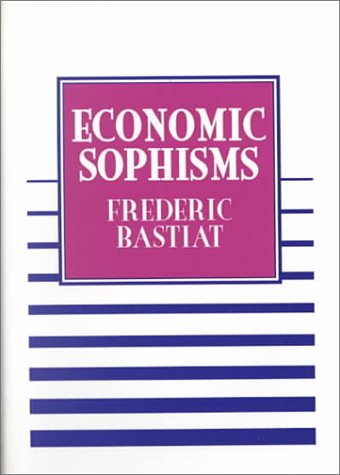
I leave you with this: a great text, from The Great Man Himself. I have a few other recommendations for economics reading, more short essays with great economic realizations and truths that you can get through in one sitting, but I’ll save those for later.
Farewell, until next time.
If you liked this article, please subscribe to my blog by clicking the blue “Follow” button in the upper right corner (at the bottom of the article if you’re on your phone or tablet) to receive an email every time I post, which isn’t that often. And of course feel free to share it if you know someone else who may enjoy it.
“A polymath is someone who is interested in everything, and nothing else”

While I’m not much of a drinker, I do like a sip or a glass or two now and then. A glass of wine or scotch goes well with a night at a jazz club, a nice dinner, an evening with friends, and melancholy thoughts. Even, as I discovered this week, occasionally with writing.
My baseline scotch is Macallan 12. It’s nice and smooth, just a little dark, and not too peaty. I discovered a similar style of scotch in a brand called Monkey Shoulder, which a friend bought for my birthday a few years ago (and another friend drank 3/4 of while visiting from California). Again, smooth, a nice little punch, and not very peaty. Recently, while frequenting one of my favorite bars that in my opinion has the best burger in Minneapolis, I tried a glass of Arran 10 year (page 8 on the menu). It’s one of their more affordable scotches, but I like it better than most of the more expensive ones I’ve had.
Since I drink very little, a bottle at home will last me a long time. But, I like to have a little variety. Last weekend I bought myself a bottle of Macallan 12 to have at the ready, and this weekend I bought a bottle each of Monkey Shoulder and Arran. Now I’ll have a nice little stock ready whenever I fire up some Coltrane, find myself in the mood to watch La-La-Land, or have some friends over to listen to music and solve the world’s problems.
What’s your favorite scotch? Do you have any suggestions? I’m always willing to learn.
Here’s what my completed collection looks like:





A coworker asked me this week what I’ll be doing for St. Patrick’s Day. I told him “Staying inside, locking my doors, and boarding my windows.” While I love and respect Irish culture, what this holiday has turned into is literally my least favorite day of the year to go outside and venture out and about. It is the ultimate “Bro Holiday,” and when it comes to being around wasted bros, young and old, yeah thanks, but no thanks.


One year when I was living in New York City, I went out at night and was getting more and more pissed everywhere I went because I couldn’t figure out why there were so many douchebag bros everywhere I went. It actually took me a couple hours and a few bars to realize it was St. Patrick’s Day. About ten seconds after my “Ahhhhhh, FUCK!” moment, I bounced the hell out, ran to the subway, and zipped home as fast as I could.
That being said, while in my opinion there is not much to love about the holiday, there is MUCH to love about Irish people and Irish culture. The first time I ever met an Actually Irish Person was at a pub in a small town in Germany when I was 19. It was your standard fare Irish pub, small, wooden furnishings, a husband and wife acoustic duo playing on stage. I ended up chatting with a bearded Irish man in his 50s and his gorgeous blonde wife who was probably around 35.
Two things stand out to me from that conversation. One was when he put his arm around me and said “Son, if yeh ever want to learn how to drink and fight, come to Ireland and I’ll show yeh.” He was a pretty warm, friendly guy, and I’m pretty sure this was a serious offer. The second is a very strange and funny scenario that happened upon our parting. As I was leaving, his lusty, busty, gorgeous wife gave me a long, warm, dare I say sensual good night hug, which positively tingled my young virginal body with delight from head to toe. And I’m sure she knew it. After holding and squeezing my quivering, frail body for a few seconds, she smiled and let me go. When I then went over to her husband and shook his hand, he gave me a hearty handshake, smiled his big friendly smile, said something about how good it was to meet me, and then, still holding our handshake, lightly punched me in the jaw and said “And stop looking at me wife like that!!!” before laughing like a bear and pulling me in for a hug.
If that’s not Irish, I don’t know what is…
Many years later, when I was in my early 30s, I dated an Irish cop for awhile. Gráinne was the very definition of a bad ass bitch. How was she bad ass? Oh, let me count the ways. First, I should relate the story of how we met. I was drinking at my favorite neighborhood bar in New York, sitting alone and relaxing. I saw her and was just dumbstruck by her beauty. She was your classic Irish beauty, tall, slender, dark haired and fairest skinned. She also had a presence, an aura, a magnetism. She was with some friends, and it would have been the height of uncouthness to approach her this way. So, being sly, when I noticed one of her friends walking back into the bar after having a smoke outside, I gently touched her arm to get her attention, and said “I think your friend is gorgeous, can I ask if she’s single?” She told me that she was, indeed, recently single, divorced in fact. BUT, the group of people she was hanging out with were her husband’s friends, so unless I enjoyed receiving a good beatdown behind the bar, I should very much stay away from her tonight. So I just said “Well, tell her I think she’s amazing, and if she’d like to talk to me, let me know.” Not long after, her friend returned with a slip of paper and said “She likes you, she said to call her.” My heart went utterly aflutter.
So besides being gorgeous and having a magical aura, why was Gráinne so bad ass? Well first of all, she was married to a man for a long time, working and paying the bills while he went to medical school. I learned that she was divorcing him just as he was about to graduate. To me that speaks very highly of her honor, integrity, and self-respect. I don’t know if there are many women, or men for that matter, who would support a spouse through something as challenging as medical school, and when they feel it’s not working out for them, leave just before the payout, so to speak. This is really a high-caliber person sort of thing to do. I think that most people, even if they thought divorce was inevitable, would have lied to themselves and their loved ones for at least a few years in the expectation of more favorable terms should the divorce come to pass. I really can’t say enough about how much I respected her for this move. To this day this is one of the most honorable things I’ve seen a person do.
The other thing that made her so bad ass was her unicorn-like combination of beauty and toughness. She was all of 5’10”, yoga-slender, ephemeral…and also a New York City cop, working midnights in some of the toughest neighborhoods in the city. I must now relate another story that conveys both her beauty and her integrity. She was approached by a modeling agent at one point in her 20s, and picked up to model for Versace for a bit. She made about $25,000 that month. But she only lasted a month. She said the models were as shallow and vapid as you’d expect them to be, and being a smart chick, could not stand being around, in her words, “those dumb bitches” all day. So she quit. Again I ask, would you quit a high status, lucrative modeling job because you were annoyed by the people you were working with? Let me answer for you: NO. I sure as hell wouldn’t. I might tough it out for a few years and sock some cash away, but I’m pretty sure that’s a move I would not make.
On the other side of the coin of her beauty was her toughness. She would often text or call me at 3 or 4 in the morning telling me about how she just chased down and tackled some drug dealer in Washington Heights, or had to fight a guy who was resisting arrest. She absolutely loved that aspect of her job, and was thrilled every time it happened. She also used to send me texts from the gun range about how firing her pistol turned her on, how shooting a gun was so erotic, and could she please come over in an hour. I got an unusual number of texts from her about her guns, sometimes mentioning what a pain it was driving between states with her pistol underneath her seat, talking about her favorite gun and asking what was mine, or some other quirk about gun use and ownership. She was an ephemeral fairy who liked to fight drug dealers and was in love with her guns.
How this all relates to St. Patrick’s Day is one of the best comments she ever made when I took her to my favorite Irish pub, on 72nd street. It was an off night, say a Tuesday perhaps. We were chilling in a corner eating and drinking at a table, and in walked a gaggle of bros wearing green and being all “We’re so wild, and so IIIIIIRISH!!!!” She looked at them the way you’d look at a maggot in your cheese and said “I fookin’ HATE plastic patties….” I had never heard this term before. After I stopped crying from laughter, I had to ask her what a plastic patty is. A plastic patty is someone who’s not FROM Ireland, but is more Irish than any person who actually IS. This is fucking brilliant, and perfectly describes what it is that I personally hate about St. Patrick’s Day, and many Irish pubs in general. For me, to be on a date with the most quintessentially Irish woman I could imagine, and hear this coming out of her mouth, followed by a litany of profanities, was the most wonderful thing that could happen to me.
I’ve since met other fine folks from Ireland while out and about, but these experiences are the ones that made me really develop a love and fondness for Irish people and Irish culture. While I find the whole get-up about the holiday pretty shallow and fabricated, I do love that the Irish people have a rich culture, a sense of honor and tradition, and most of all, a sense of humor. If I ever find myself invited to celebrate with true Irish people on this day, then you can absolutely count me in. Until then, you can summarize my feelings on St. Patrick’s Day as this:

Happy St. Patrick’s Day everyone, have fun out there!
As a lifelong Marvel comics fan, who has been reading them since Captain Marvel was a black woman (in 1982) and led the Avengers (in 1987), I have a stronger than average interest in Marvel movies, understanding of their characters and story lines, and emotional investment in their success.
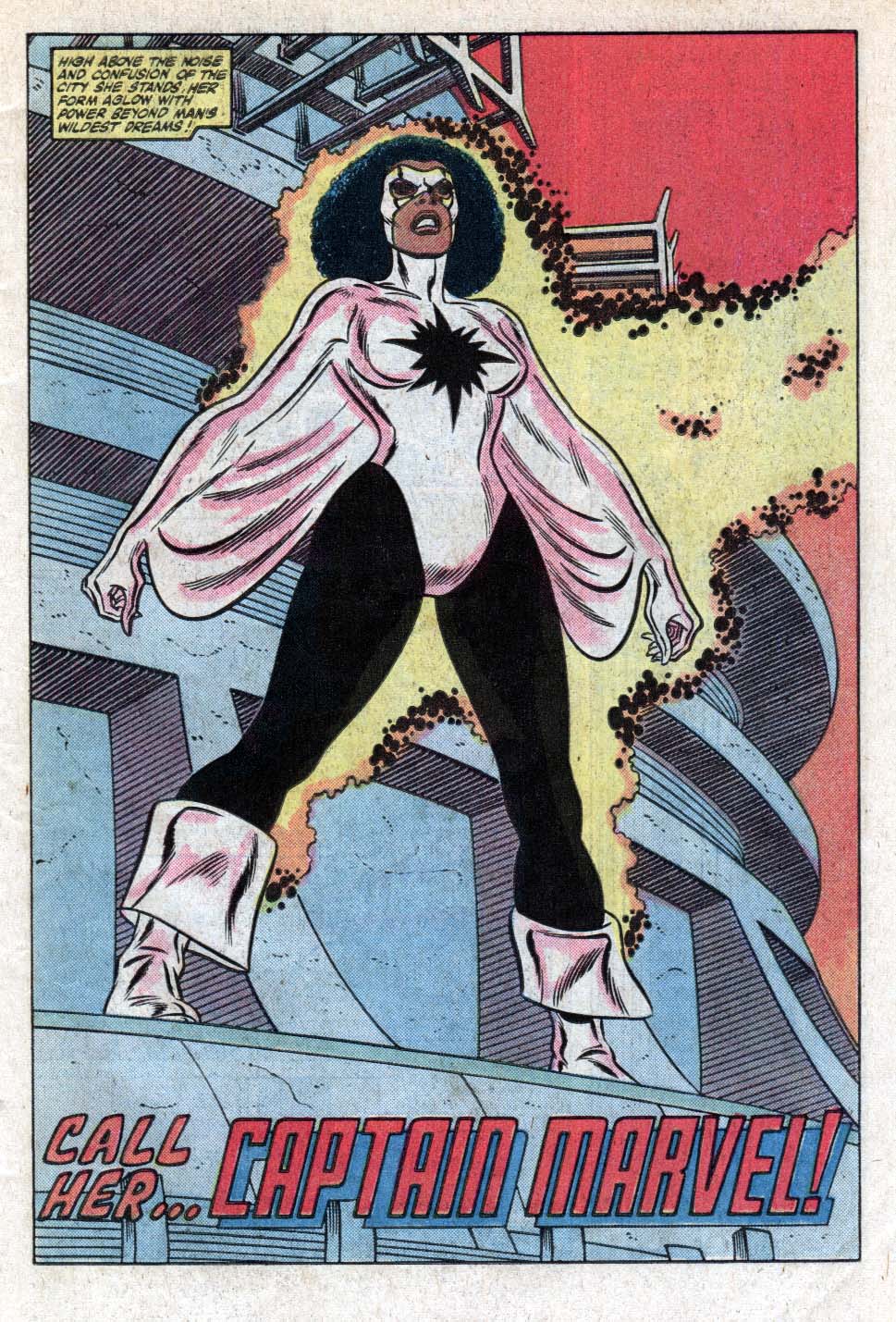

I’m about to rush out for dinner, then see a movie about a character I’ve been following for over 30 years. Marvel’s movies in the Avengers series haven’t let me down yet, but the previews for this one leave me with one underlying concern: is Captain Marvel a Mary Sue? Because she’s definitely being marketed as one.
What is a Mary Sue? If you’re even a moderate movie lover, this is a term you should be familiar with. If you’ve seen the latest Star Wars movies, you definitely know what a Mary Sue is, even if you weren’t aware of that term or had heard the concept articulated before.
I don’t have the time to explain it right now, and honestly it’s more fun to discover what it means while being entertained. I only found out about this last year, in a discussion about Star Wars with some friends. Someone said “Rey is a Mary Sue” and I said “Who is a whatsa whosis…?” And then they showed me these:
So I’ll be crossing my slick, buttery fingers tonight that Marvel has not fallen into this trap, and does a better job of character development than Star Wars/J.J. Abrams did.

Excelsior!
As some of you may know, I moved to New Orleans in 2009, to the burning Heart of Darkness, the French Quarter itself. That’s right, that is indeed the year the Saints won the Super Bowl, and I saw almost every game at different bars in New Orleans, and watched them beat the Vikings in the NFC championship at a swanky society party in the Roosevelt Hotel. I spent three glorious, heart-wrenching years in New Orleans, two in the Quarter, and one in the suburbs. There is an essay, or a book to be written about that someday, certain to be assisted by copious amounts of wine and absinthe.
But for now, in honor of Fat Tuesday, I present:

You’re welcome.

“Sometimes you have to fight, even if you know you’re going to lose.”
— A Wise Man
I had this thought yesterday, as I was driving to the gym, over-intellectualizing something, as usual. There was no real particular context, I was just pondering life in general…my life, historical figures, etc. There are some prominent examples from American history that immediately come to mind, like George Washington and Abraham Lincoln, and the men who fought with them. When they took up their fights, they seemed impossible, and the prevailing wisdom and inescapable logic of their day was that they were going to lose, quickly and badly. But they fought nonetheless because they believed it was the right thing to do, knowing that they would likely lose everything, including their lives.
Now there is another lesson from those two examples, which is important, but not the one I have in mind: sometimes a fight may seem impossible, but you fight anyways, and even against impossible odds, you may win. So many wars and battles teach this lesson, as well as many less dire and existential social, political, and interpersonal struggles. This is definitely an important thing to know.
But so is the original point: sometimes, even if you sincerely know you’re going to lose, you have no way to win, you expect to be beaten, and your fight turns out exactly as you expect…you have to fight anyways. Because to be a person, to be a man, to be a woman, you have to have something you believe in, someone whose back you have, something worth fighting for or dying for, or you’re just a mindless beast. There has to be something you stand for, something you believe in, someone you would protect, even at the greatest cost to yourself, because otherwise you’re simply a brute living on selfish instinct.
I heard a line in an overlooked movie 20 years ago that said this well, that was actually my first inspiration for this insight. I couldn’t remember the exact line, but I remembered the sentiment, and it has stayed with me, and bored its way ever deeper into my psyche, ever since. I reflect on it whenever I think deeply about what I would do for who and what is important to me. After 20 years, I have finally found it, researching for this piece. I hope it makes you think half as much as it has me, and helps you clarify what you care about and what you would fight for as it has done so well for me.
“I condemn those indifferent mortals, who either never form opinions, or never make them known.”
— Alexander Hamilton
As I mentioned in my last post, America is staring down the barrel of an impending financial crisis, and the question is not if, but when we’ll have to eat that bullet, or several of them. Put simply, we have an out of control spending problem with both entitlement programs (Social Security, Medicare, Medicaid, etc.) and national defense. Each of these expenditures are currently at monumental and unsustainable levels, which are going to have to be dealt with eventually. Making matters worse, both of the parties in power, as well as the majority of American citizens, are quite unwilling to look this problem squarely in the eye, let alone do something about it, so the most likely scenario is that rather than solving it before it causes a massive economic crises, everyone will just keep their eyes closed and heads down, hoping to get as much out of it as they personally can until the gravy train runs out.
Neither party is going to do anything about it because as I previously mentioned, Republicans are religiously attached to an infinitely increasing amount of defense spending, and Democrats seem to have the same feelings about entitlements. To Democrats, our problem isn’t that we spend so much on entitlements that we’re careening towards a humiliating national bankruptcy, but that we don’t spend nearly enough on them. To Republicans, there is literally no such concept as “too much defense spending.” It’s a thing that they don’t recognize as existing in the universe. And as bad as Republicans are on defense, Democrats explicitly want to add trillions more to our spending and debt problem by vastly expanding entitlement programs generally and specifically, for example by enacting jaw-dropping expenditures like Medicare For All.
And then of course, there is the fact that neither party wants to upset voters by even talking about taking away or reducing entitlements they’ve grown used to. Which, a conservative would argue, is exactly the problem with too much government and too much reliance on it. It’s also why government can never shrink, only grow: once someone gets used to having something, you can’t take it away from them, at least without incurring a massive political cost which likely amounts to career/party suicide. Liberals count on this whenever they pass new entitlements, such as the ACA for example.
So for the foreseeable future, American voters will continue to force their politicians to keep kicking the can down the road. But something that can’t go on forever, eventually will end. And the longer it goes on, the harder and uglier that end will be.
Earlier I mentioned eating bullets. There are several types of economic bullets we may be forced to eat, and they are all equally unpleasant:
— Massive tax increases (on everyone, not just the wealthy)
— Hyperinflation, as the economic geniuses in our government try to print money to get out of the crisis they’ve created
— Massive austerity, in general and in cuts to the very programs we are so attached to that are taking us down this road
We are definitely going to have to eat one of these, if not some combination of all three. I’ll say a bit about each one.
Tax Increases
One of the core tenets of liberal/left-wing politics is a fundamental belief that we can pay for every single program and entitlement we ever dream of if we only tax “the rich” enough. There are a lot of philosophical and economic problems with this point of view and the overall hostility towards “the rich” on the left, but the one relevant to this particular issue is this: there is simply not enough money in the hands of “the rich” to solve this problem, even if we confiscated every single dollar from every single one of them. The only possible outcome if we rely on tax revenue to balance our budget is a massive tax increase on everyone, from the richest person all the way down to the poorest individual we as a nation decide to tax. What this future looks like is a lot like present-day Europe, with tax rates at 50% and well above, up to 60 and 70% of income, for rich and middle class alike, large value-add taxes (sales taxes) on top of that, and even outright confiscatory taxes on overall wealth, such that a person could be taxed at more than 100% of their income in a given year if they’ve committed the economic sin of being “too rich” overall through the course of their lives. This is a system and an economic view that the left admires and sees as the most virtuous vision for our future, so that is definitely not a philosophical or economic problem as far as they are concerned. Any way that we can be more like “Enlightened Europe” we should, including spending 50-70% of our work hours to pay the government to spend as they, in their infinite wisdom and grace, see fit. This is definitely a debate we should have out in the open, both because I would like to see the left defend this view economically, rather than on the basis of emotional anecdotes about people who could benefit from an infinitely increasing social safety net, and because I don’t believe that they could persuade a majority of Americans to their position, if we discuss it in unemotional economic terms.
Now for an absolutely crystalizing illustration of why tax increases on the rich or in general cannot solve this problem, and proof that we have a spending problem rather than a revenue problem, Tony Robbins has put together one of the most impressive presentations on any subject I’ve ever seen to address our nation’s spending for one fiscal year. I’ll link from where the relevant part of the presentation starts, which runs about 15 minutes, but it’s worth watching the whole 20 minute presentation as well to help grasp the scope of our spending problem.
https://youtu.be/jboTeS9Okak&start=322
The bottom line on taxes is that
1. There is no possible tax increase that could even pay for our current annual spending, let alone resolve our long-term debt
2. Any attempt to do so will raise taxes to catastrophic, economy-killing levels
3. Such tax increases will be across the board, not just on “the rich”
Hyperinflation


Benefit cuts/austerity
When unsustainable spending reaches its end, when a ponzi scheme runs out of rubes, when your last check finally bounces…then, at last, you will stop spending, because you are forced to. When we run out of money to spend on these benefits, we will be forced to as well. When that day comes, we will require truly massive reductions in benefits to these programs, and likely other fiscal austerity measures, in order to be able to fund them at all, at any level. To understand why this will be necessary, we need to understand how we got here.
Sometimes it helps to use relatively small, digestible numbers to help us understand trends and patterns that involve bigger numbers or a big problem. So here are a few numbers to help us understand what we’re dealing with in regards to entitlement spending over the next few decades:
— Every day, 10,000 baby boomers turn 65 (about 4 million a year)
— When Social Security was first passed, there were about 42 workers for every beneficiary
— In 1950 there were 16 workers for every beneficiary
— We are now at less than 3 workers for every beneficiary (2.8 in 2016)
— In the next 15-20 years, we are approaching 2 workers for each beneficiary
I hope those numbers hit you hard and give you pause, as they did me. Let’s sit with this for a minute, with a couple of helpful graphs:


Now I’m no mathematicical genius, but to ME, that looks unsustainable. I know intellectuals like to talk a lot about nuance and complexity when it comes to public policy, and certainly understanding every aspect of an issue and crafting specific laws and regulations is a pretty complex and nuanced undertaking. But I prefer to focus on breaking things down to the core facts and fundamental principles, to examine the foundations so that we can actually understand these issues and the big picture reality and problems they represent. Understanding is the first step on the journey to solutions, and that requires breaking things down to their core.
Now I just said I’m not a mathematician, so I can only offer what come to mind as simple, common sense first steps to at least alleviating the stark arithmetical problem above. The first would be to raise the retirement age. When Social Security was first passed in 1935 with a retirement age of 65, the average life expectancy for men was 60 and for women was 64. In 1960 they were 67 and 73, respectively. Even as late as 1980, it was 70 and 77. Now we’re looking at 77 and 81 for average life expectancies.
But, good news for the elderly: it’s even better than that if you make it to retirement age!

The point I’m trying to make, what nobody tells you, is that when social security was first enacted, it was never intended or imagined as a subsidy from the rest of society to live 20 more years without working. It was more like a social welfare benefit you could count on if you struggled to pay your bills in your old age (as defined then), if you could no longer work or had no family that could help take care of you. And even then, it wasn’t intended for you to collect for decades, but for a few short twilight years.
As one analyst noted:
Although “mid-sixties” is typically the age range defined as the beginning of retirement, history shows that until fairly recently, it was common for men to be employed after they reached 65. In 1880, 76 percent of men were employed at age 65, a proportion that declined to 43 percent in 1940, and 18 percent in 1990. Although the current recession has caused more workers to postpone retirement, a 2009 survey of retirees found that 84 percent had entered retirement at age 65 or earlier.
When Social Security was established in 1935, state pension systems were split equally between those that determined 65 as the retirement age and those that determined 70 as the retirement age. The Commission on Economic Security, which designed the system under FDR, was swayed to adopt age 65, partly because the federal Railroad Retirement System, which was established in 1934, used 65, and partly because analyses at the time showed that 65 was actuarially feasible at low levels of taxation [emphasis mine].
Let’s dwell on that last link and point again:
Taking all this into account, the CES planners made a rough judgment that age 65 was probably more reasonable than age 70. This judgment was then confirmed by the actuarial studies. The studies showed that using age 65 produced a manageable system that could easily be made self-sustaining with only modest levels of payroll taxation [emphasis mine].
See, the thing about Social Security, Medicare, or any other social safety net or benefit is that they’re noble, they’re compassionate…and they’re luxuries. These are great institutions and policies for civilized societies and advanced economies to enact…if they can afford them. But it seems like the “if we can afford it” point was lost to history somewhere. Now we decide what we want and cook the books and kick the can to finagle it, rather than figuring out what we can afford and crafting policy from there. Doesn’t that seem kind of backwards, if not outright irresponsible?
And this is how we arrive at our current untenable situation regarding Social Security. We’ve come to view everyone’s individual retirement at 65 as some sort of inherent, god-given right, and the taxpayer subsidy along with it. But rather than an individual retirement plan, doesn’t social security make a lot more sense as a safety net for those who just happen to need financial help in their old age, rather than the economic right of anyone over a certain age to have wealth transferred from younger working people, no matter how well off they may be in old age?
It’s right there in the name: “Social.” “Security.” Doesn’t that sound like a…I don’t know…safety net, rather than a taxpayer funded 20 year vacation? Doesn’t that sound like a plan for a compassionate society to help senior citizens in need, and specifically those in need, rather than the primary source of retirement income for the vast majority of Americans? Especially when you consider how much healthier and active each generation of retirees is than the last, doesn’t it seem reasonable we should expect them, and ourselves, to work longer than previous generations, well past 65?
This isn’t something that can, or should, be done overnight, or sprung on elderly people who have relied on this promise and expected to retire in their 60s for their entire working lives. But it is something that we can phase in, say perhaps raising it one year at a time in five year generational increments, let’s say starting a decade from now (or whenever we get off our asses). The retirement age is currently being incrementally increased to 67, but that is a statutory change enacted 35 years ago, based on obsolete actuarial tables, and before we blew out our debt like a prom dress at a Springsteen concert.
Imagine if we applied the actuarial tables of 1935, the year Social Security was enacted, to today’s retirees. Using the same math, you wouldn’t be eligible for Social Security until you were 82, a year past the average female life expectancy and five years past the average male life expectancy. Does that help clarify how drastically out of proportion our current system is to its original intent, and how different the worker-to-retiree ratio could be?
Now I agree with what you must be thinking, that we are a much more compassionate and civilized society than we were in 1935…and a hell of a lot richer, too. Fair points. But when you understand where we are versus where we came from, and compare the two versions of the same system side-by-side, it helps clarify what’s happening and where we’re headed, and can maybe help us think about what to do about it.
All of which is the $10,000 way of saying “raise the retirement age, Stupid.”
Final point on Social Security: it should be means tested. Again, look at the name. I know this is controversial, and people are emotionally attached to “their” social welfare benefits that they “earned” when they “paid into the system.” Like a lot of harsh truths, this is something that people don’t want to hear, but must be told, and must accept if they wish to avoid economic disaster: we cannot afford Social Security as a program that everyone is entitled to, but only as a safety net for those who need it. This will require some radical rewiring of Americans’ expectations and notions of what Social Security is, which is why reform is just as unlikely to emerge from grass roots public opinion as it is from congress taking the initiative, especially since the one precedes the other.
But like it or not, it is true. Our whole notion of Social Security has to be revamped to be understood as a safety net, or it will not survive, and our economy will, eventually, buckle under its weight.
Here’s a depressing graph to help get the point across:

A couple of anecdotes nicely illustrate my point. A distant relative of mine had a very successful career, and in retirement, received a pension of just over $100,000 annually, which was on top of substantial earnings that allowed him to save for retirement and accumulate assets throughout his life. Can you really justify taxpayers forking over social welfare benefits to him for 20 or 30 years, as some sort of “security” guaranteed by “society?” Wouldn’t it be better to save that money, leaving it in the pockets of today’s workers, who are still building their families, careers, and wealth? Or, if need be, redirected towards individuals truly in need? Whether you’re liberal or conservative, this should be a layup: lower taxes, or more resources going to the truly needy…or both!
On an even more ridiculous level, munch on this, if you will: I have friends at all levels of society, some fairly high. Some of them rub elbows with millionaires and billionaires, and have told me that when they turn 65 and are eligible for Medicare* and Social Security, these guys get super excited about it. I mean, really! They will literally go on about how they just signed up for Medicare, or just received their first Social Security check…like this is the accomplishment they’ve been working towards their whole lives, not their first million or their first billion. What do they do with this lunch money, you may ask (I sure did)? Buy a cheap car to toodle around in at their vacation property. Give it to their grandkids for an allowance, or for spending money in college. Who knows what else. This particular group is a small percentage of retirees, but this extreme example illustrates the principle: it is a ridiculous public policy to spend “social welfare” money on people who have done very well in life. But even these people would most likely fight tooth and nail to defend “their” social welfare that they “earned” when they “paid into it.” You see the problem here…?
What I hope I have conveyed in this section is how dreadfully unsustainable our current approach to retirement benefits is, from an economic standpoint, and a sense of how disastrous the train wreck is going to be if we don’t take some pretty serious steps to restructure our system to avoid it.
*All of my arguments about a means test for Social Security apply to Medicare, and it seems reasonable to assume the worker-to-beneficiary pyramid is the same as it should be the same people
Going back to the beginning, the three pillars that are the foundation of our impending financial meltdown are Social Security, Medicare, and military spending, the latter of which I’ve addressed here.


If we don’t get our spending under control, we are going to have make some very ugly choices, which will most likely include some sort of drastic benefits cuts and austerity measures, in this and other areas of the federal budget. And of course, any plan we devise will be hasty and imperfect, so more than likely a lot of truly needy and deserving elderly people and others will be deprived of needed resources, and our county will betray the promises it made to them in the nastiest bait & switch in modern economic history.
This is the future I want to avoid, but I see absolutely no sign from either our electorate or our elected officials of even admitting these structural problems, let alone doing something about them. I fear it is far more likely that we will have a crippling economic meltdown in our lifetime that will dwarf the housing crisis of 2008. If that should occur, your most pressing concern may not be what will happen to your savings account or your 401k, or whether you’ll be able to afford to send your kid to college. It may be whether you have enough beans and bullets.
And then we will be here:
After serving you all this delicious gloom and doom for your main course, let me offer you some more for dessert. No whine. I want to leave you with a few more things to think about and a few more resources to dig into in order to further your understanding of our economic future.
See, even the depressing facts I mentioned above do not describe the totality of the fiscally irresponsible policies our country is engaged in. Those are just the most costly federal ones. But state governments have their own self-created economic icebergs, and are veering towards them just as fast. Take a few minutes to read this 60 Minutes article from 2010, and you’ll see that our national economic situation is much, much worse than I described above. The article is four pages, here are the first few paragraphs:
By now, just about everyone in the country is aware of the federal deficit problem, but you should know that there is another financial crisis looming involving state and local governments.
It has gotten much less attention because each state has a slightly different story. But in the two years, since the “great recession” wrecked their economies and shriveled their income, the states have collectively spent nearly a half a trillion dollars more than they collected in taxes. There is also a trillion dollar hole in their public pension funds.
The states have been getting by on billions of dollars in federal stimulus funds, but the day of reckoning is at hand. The debt crisis is already making Wall Street nervous, and some believe that it could derail the recovery, cost a million public employees their jobs and require another big bailout package that no one in Washington wants to talk about.
“The most alarming thing about the state issue is the level of complacency,” Meredith Whitney, one of the most respected financial analysts on Wall Street and one of the most influential women in American business, told correspondent Steve Kroft.
Whitney made her reputation by warning that the big banks were in big trouble long before the 2008 collapse. Now, she’s warning about a financial meltdown in state and local governments.
“It has tentacles as wide as anything I’ve seen. I think next to housing this is the single most important issue in the United States, and certainly the largest threat to the U.S. economy,” she told Kroft.
Asked why people aren’t paying attention, Whitney said, “‘Cause they don’t pay attention until they have to.”
Whitney says it’s time to start.
If the written word doesn’t frighten you, then by all means, watch the actual segment for more bone-chilling economic facts that will keep you up at night, wondering how many AR-15s you can buy in the next few years.
Then there was this recent projection by the Congressional Budget Office covered in the Wall Street Journal: the interest alone on our national debt is soon going to surpass even our outsized defense budget.
In 2017, interest costs on federal debt of $263 billion accounted for 6.6% of all government spending and 1.4% of gross domestic product, well below averages of the previous 50 years. The Congressional Budget Office estimates interest spending will rise to $915 billion by 2028, or 13% of all outlays and 3.1% of gross domestic product.
Along that path, the government is expected to pass the following milestones: It will spend more on interest than it spends on Medicaid in 2020; more in 2023 than it spends on national defense; and more in 2025 than it spends on all nondefense discretionary programs combined, from funding for national parks to scientific research, to health care and education, to the court system and infrastructure, according to the CBO.
Debt as a share of gross domestic product is projected to climb over the next decade, from 78% at the end of this year—the highest it has been since the end of World War II—to 96.2% in 2028, according to CBO projections. As the overall size of our debt load grows, so too do the size of interest payments.
Ben Shapiro mentioned this impending financial crisis in a recent show, and discusses the terrifying worst case scenario at 22:30 – 26:17 below.
https://youtu.be/bk006yJ0w4k&start=1350
Last but not least, this article is one of the best resources on this issue. It’s short, digestible, and discussed in layman’s terms.
https://www.smh.com.au/business/us-is-bankrupt-and-we-dont-even-know-it-20100812-12056.htmlI
If you prefer your depressing information to be conveyed verbally, most of the text is included in the video description below.
Phrase of the Day, kids: unfunded liabilities

Note: if you want to watch the embedded videos from the start time I recommend, you have to click on the embedded version and watch it on this page. Clicking it into a new tab will take you to the video from the beginning, I just learned that. They are extremely enlightening, so I encourage you do check them out if you can. If you can’t now, you can bookmark them for later or return to this post and watch them later.
If you liked this article, please subscribe to my blog by clicking the blue “Follow” button in the upper right corner (at the bottom of the article if you’re on your phone or tablet) to receive an email every time I post, which isn’t that often. And of course feel free to share it if you know someone else who may enjoy it.
Also: If you like what you see here, you can also follow my Facebook page, where I post more ground-breaking articles from other people rather than just my own work, and my Twitter page, where I just tweet.
Here’s an interesting political thought exercise: name 2-5 things you agree with “the other side” about. I say 2-5 because only coming up with one may be too easy, and if asked, I think most people could come up with some sort of token “disagreement” with their own party just to seem reasonable, and not give the question any real thought. It’s too easy to just wave it away with one. And I say five because trying to come up with five points of agreement with your political opponents can be a real intellectual stretch, and require you to emotionally leave your comfort zone of party affiliation. It makes you have to really think of “the other side” as human, to take time to consider/realize that thoughtful, well-meaning people have come to different conclusions than you have about important things, and generally increases the zone of your empathy outside of your political tribe.
I’ll start!
1. Pot/drug legalization
Marijuana legalization is probably one of the best things to happen as a social policy in my lifetime. It is the least harmful of all recreational drugs by a long-shot, and if anything, I wish our society’s relationship between pot and alcohol was reversed. If people smoked as much pot as they drank and drank as much as they smoke pot, we would be immeasurably better off.
Think about that for a few moments…think of all the violence, to oneself and others, that results from the effects of alcohol on the mind. If all of the people who drank themselves into a state of mind to hurt themselves or others had gotten similarly intoxicated on marijuana, it’s probably safe to say that the majority of intoxicated incidents of violence would not happen. You are probably not going to get high on weed and go out looking for a fight. Honestly, I’d like to meet the person who would, just out of curiosity.
In the big picture, all drug addictions should probably be treated as health problems and not criminal problems. And society is moving in that direction. A moment that startled me and helped me realize just how far we’ve come and in what direction we’re headed is seeing an interview with Christ Christie in 2015 while he was pursuing the Republican nomination for president, in which he says just that: we need to think of drug addiction as a public health issue and not as a criminal issue.
It might take a moment to appreciate what’s happening here…a former federal prosecutor and a presidential candidate for the “tough on crime” GOP was publicly making the argument for decriminalization. We’re nowhere near that point from an institutional policy perspective, but policy doesn’t change until social mores change. The law is always a laggard behind public opinion. But the public consciousness is being raised on this issue, and we’re moving in the right direction.
Legalizing drugs would also largely end gang violence by taking the money out of the drug trade and leaving them nothing to fight over. This would save thousands of lives per year from that violence, boost the ever living hell out of the economy by moving a major economic sector off of the black market, create mountains of new tax revenue, and create a world where inner city kids can focus on getting real jobs and developing professional skills rather than falling into a life of degeneracy and hopelessness as permanent outsiders from normal society. Imagine inner cities being safe places where people can work and children can go to school peacefully…that is what’s at stake in our decision to end or maintain the drug war. But it’s a fact that you will almost never hear conservatives (other than libertarians) discuss.
Last but not least, legalized and regulated recreational drugs would remove the uncertainty for recreational drug users wondering what their product contains, and save many lives from horrific and painful overdoses due to what they ingest being cut with god knows what toxic substance by unscrupulous drug dealers with no concern for the safety of their customers. Occasionally, to my disgust, I’ve heard people brush this off with the only semi-cogent argument against this fact, which is a callous disregard for the lives of drug users, a sort of puritan “let them die” mentality that you might have heard spoken in a John Wayne voice 50 years ago. But if you actually think of drug users and drug addicts (there’s a difference) as human beings whose suffering you care about and would like to alleviate, then having a clean drug for them to use is a tremendous boost to their safety. If you are the sort of person who clings to a “let them die” mentality, then take at least a minute to be honest and wish the same for yourself if alcohol was outlawed again or for your grandparents when they lived through Prohibition.
As I said, we are collectively making progress on this issue, and there actually seems to be a consensus on marijuana among both parties for anyone under 60. But pretty much all of the resistance to pot legalization at both the state and federal level is from Republican holdouts. And while Chris Christie has shown himself to be pretty forward-thinking on the topic, and even Donald Trump is coming around, the overall “War On Drugs” continues, destroying countless lives through criminalization, costing ungodly sums of money in enforcement, and creating perverse economic incentives that destroy even more lives by putting the drug trade on the black market and diverting the profits to whoever happens to be the most ruthless killer. And while your average Republican is starting to progress on pot and addiction generally, there are still very few voices among Republican politicians, leadership, or thinkers willing to comment on these topics.
2. Defense spending
To put it bluntly, Republicans are off their f**king rocker on this topic. We could cut defense spending by 10-25% without even blinking. We could likely reduce it closer to 50% of its current threshold and still be able to annihilate the rest of the world ten times over. Republicans are deaf, dumb, and blind on this issue, and frankly irrational to talk to about it. The addiction to a seemingly infinite level of defense spending is like a drug to Republicans, or maybe a religious belief or some kind of cult, and it drives me freaking CRAZY.
I’m a self-professed neocon, I’m a veteran who has gladly participated in a peacekeeping military intervention, I believe in a strong and vigorous foreign policy, and I firmly believe in American leadership on the international stage. You can even count me in the camp supporting a Pax Americana sustained well into the future, to the end of my lifetime and beyond. If it needs to be made any clearer, I supported and continue to support both the war in Afghanistan and the war in Iraq.
What I don’t support is wasting billions or trillions of dollars. Here is just one example of the tremendous, unfathomable waste involved: aircraft carriers. Ask yourself this: who are our main threats or enemies in the world? Are you thinking of the two that came to my mind? Let’s see where we stand against them in terms of aircraft carriers:
Russia has one
China has one
We have eleven
The entire rest of the world has ten. And all of the others are either our allies or, at worst, neutral. I’m not particularly worried about the threat posed by Brazil or Thailand’s aircraft carriers, are you? Why don’t we try, I don’t know, surviving on eight and see if the world doesn’t come to an end, while we drastically reduce our budget deficit and/or tax burden? If we wanted to go really crazy, what if we reduced our operating aircraft carriers to *shudder* five or six? You know, three times more than both of our only real threats combined? How much is each one of these things costing us that could go back into our pockets? Would you like to know? I certainly would.
I will admit that I’m not an expert on this topic, but it’s certainly worth digging into. A trillion here, a trillion there, pretty soon you’re talking about real money.
The aforementioned list, by the way, “does not include submarine aircraft carriers, seaplane tenders, escort carriers, merchant aircraft carriers, helicopter carriers or amphibious assault ships.” How many classes of expenditures are there like this that we could cleave from the budget and reclaim for taxpayers, while still remaining the most dominant military force in human history? Forget $500 hammers, how about $13 billion aircraft carriers?
My success with even having a civil conversation with Republicans about this issue is about equivalent to the number of christians I’ve talked out of believing in Jesus. They put up the “I’m not even discussing this” force field, proclaim some sort of superior insight into “the real world” or “security” that they presume I don’t have, even when they have never served in the military. I literally had a guy walk away from me at a fundraising event for a Republican candidate in Minneapolis. It was pretty impressive, he was able to pull it off in under a minute, the “You obviously don’t know what you’re talking about” head-to-toe glance over and walk away, in one smooth movement. It was the sort of treatment I get from liberals when I try to talk to them about say race or gender, and one of the reasons I choose to be a conservative is that I don’t find this sort of behavior among conservatives when we talk about political issues…except on this topic. I swear that Republicans are more willing to debate the literal truth of their religion with you than have a factual debate about military spending. In my experience this is the main area of willful ignorance and avoidance in the Republican party. When a person or a group of people won’t even discuss a topic, that’s a pretty big red flag that it’s a religious belief, not a thoughtful position arrived at by deliberation, and that they know it.
Defense spending, more than any other issue, puts the lie to the “fiscal conservatism” that Republicans profess to believe in. And unlike many issues, where the party leadership is out of touch with or simply ignoring the base and acting against their wishes, as far as I can tell the Republican base and leadership speak as one on this issue: there is literally no such thing as “too much” defense spending.
What angers me the most about this position, beyond its terrible reasoning and ideological blindness, is that it makes long-term budget reform politically impossible, it guarantees that our country will never reduce our deficit or balance our budget, because it makes reciprocity or compromise with Democrats impossible. The message I’m trying to get through to Republicans is this: if you want Democrats to give up anything on entitlement reform, we are going to have to give up something on military spending. It’s a well known fact that the three things that are breaking our nation’s budget and sending us towards a humiliating national bankruptcy someday in our children’s future if not our own, are Social Security, Medicare, and military spending. As a conservative, I strongly favor tax cuts to lubricate the economy and foster economic growth, but such growth has to come with major reform and reduction of entitlement AND military spending in order for us to be fiscally healthy again. But I see absolutely no willingness from either party to touch their sacred cow, both from the base and the leadership, so that means we’re just going to push this ship full steam ahead until we hit that economic iceberg.
In case you’re wondering what that iceberg is going to look like and when it’s going to hit, here’s a bit of info on it (open up the “see more” section of the video’s description to read the original article).
[Note: I explored this topic further in my follow-up article, American Bankruptcy]


3. Gay marriage
Honestly, I don’t even think this is a thing anymore, except for extremely religious Republicans over 60. Everyone else is on board. But those who aren’t are just behind the times. I don’t even know any Republicans who don’t support it, but I’m sure they exist, more in religious and rural areas. This battle is over, the right side won, and it’s not even a discussion anymore. But when it was a contentious issue over the last couple of decades, I was always staunchly opposed to the Republican position against it.
4. Planned Parenthood
So to make my own position clear up front, I’m a pro-choice Republican, at least at the beginning of a pregnancy. And to be honest, I’m struggling with this issue more lately. Because if anyone who is pro-choice is honest, you can’t draw a clear, distinguishable line between when it is acceptable and when it is not. A lot of liberals like to walk away from me at this point, when this undeniable logic is mentioned, but you have to face it if you want to be honest about the issue. If you’re honest about a topic and your own position, you have to admit where it has weaknesses or unknowns.
And I don’t know if you’ve ever looked up what they do to “terminate” a pregnancy once the fetus starts to develop, but if you haven’t, you absolutely have to if you want to have an informed opinion on this issue. I personally can’t get through an entire article describing the procedure, and in case you didn’t know, once you get past the first few weeks, it’s not like simply “expelling” a blob from your body…they have to kill the fetus. Yes, kill it. By, say, dismembering it or vacuuming out its brain. If you’re pro-choice, you have to face this, and should read some articles about the procedures, maybe look at some diagrams, and try to imagine the procedure in every detail from start to finish, and then see how you feel about it.
But this war on Planned Parenthood is a ridiculous red herring and a monumental waste of time and political capital. I could not believe how much time was wasted on it in our local caucus in 2016, and I was clearly unwelcome when I questioned it (that is its own story/post). There is still a demonization of Planned Parenthood from Republicans like they’re fighting Satan Himself (and I’m sure some of them think they are).
Now on this or any other issue, it’s fine and normal that people will have different opinions, and be passionate about it, and fight about it. That’s normal in politics. But it’s infuriating to deal with conservatives who seem to think they’re fighting Nazis here, when they don’t even know what Planned Parenthood does. And I find very disturbing the degree to which they dehumanize the people who staff that organization (which is about on par with the degree to which I find most liberals dehumanize anyone who is pro-life). In a civilized society, we should never see people who disagree with us on a political issue as monsters, and I’m just as disturbed when “my side” does it as when the “other side” does.
As contentious as the months after the 2016 election were, and as many Facebook wars as I had with hysterical liberals about the end of democracy and President Hitler, I’m almost proud to say that my first block of 2017 was from a hysterical Republican over Planned Parenthood. He was ranting about how evil they are, and I simply posted a chart showing how much they spend on various services, and asked what his objection was to the majority of their work (hint: it’s almost entirely other female health and reproductive services). He blocked me within less than a minute, another record of which I am proud.
I understand why conservatives don’t like Planned Parenthood for its abortion services. I can understand why that makes them angry, because unlike many people who are pro-choice, I can see how someone could disagree with me on this issue, and respect their disagreement. What I can’t stand is how most conservatives seem to completely ignore literally everything else Planned Parenthood does. The plethora of health services they provide is vital to the health of so many women, and they provide a lot of services for women who could not otherwise afford them.
And conservatives should be especially thankful for the free and low-cost birth control they provide, because more birth control equals fewer abortions. I mean, this is just about the best thing any organization could do to prevent abortions: how many fewer abortions are there because Planned Parenthood and other organizations provide birth control to women who could not otherwise afford it? They should literally be praying for as much birth control and contraceptive education as Planned Parenthood and other organizations can provide. But this view requires some nuance, and also requires one to do some minimal research into what they actually do. For pro-life conservatives overcome by their hatred for Planned Parenthood and abortion in general, this seems like something they are incapable of or simply unwilling to do.
Now, for my friends and readers who are pro-choice, I have to ask you to do something very uncomfortable: I have to ask you to watch this 4 minute video which is the absolute best version of the pro-life argument on abortion. It explains, as succinctly and logically as possible, why a person would hold that position on abortion, and I can say fairly confidently that it’s an argument you haven’t heard before. It also addresses the current politicizing of the Supreme Court, no matter who the candidate is, and it speaks a very important truth about how many (in my experience most) advocates of abortion rights view those who oppose them. As hesitant as I am to do this, I have to pose this as a personal challenge, and a litmus test of whether you are willing to honestly engage the best version of the other side’s argument (only you will know whether or not you pass this test). Please take a few minutes to watch and digest this commentary, and I think you will be better for it, both in understanding the pro-life argument, and in bringing you closer to humanizing people who disagree with you on perhaps our most polarizing issue.
———-
I first wrote a few preliminary thoughts on the topic of points of agreement with “the other side” and disagreement with my own about six months ago, as it occurred to me that this would be a useful exercise for myself and a helpful conversation starter with liberals, demonstrating that I think for myself and come to my own conclusions, rather than simply toeing a party line or regurgitating talking points from my preferred conservative news outlet, which is one of the first things liberals start saying to me when they want to get nasty.
For the record, I actually get almost all of my news from NPR, CNN, the New York Times, and other liberal outlets. Like, 95%. A full 90% of my news and information comes from NPR alone, which I listen to every day both ways on my commute, continuously at home, and for coverage of any major event. I’ve even supported them financially as a subscriber/member.
And no, I don’t watch “That Station.”
I also think a conversation like this is a demonstration of goodwill and open mindedness, showing that you are willing to consider arguments from people who disagree with you, that you are open to facts that may counter your current views, and that you aren’t overly invested in your “team” winning and partisan party politics. Also that you’re just a decent human being who can get along with other human beings even if you disagree about some things, and more important, see them as human beings. There’s a whole other conversation to be had about how politics isn’t everything, about how we’re all in this together, and how we should all love and respect each other, and not let politics poison every single aspect of our life. But that’s going to have to be another article for another day.
Ok, now it’s your turn…GO!! 🙂
PS: If you like what you see here, you can also follow my Facebook page, where I post more ground-breaking articles from other people rather than just my own work, and my Twitter page, where I just tweet.
https://www.facebook.com/Symposiarch/
Quick note — To my many friends and acquaintances with whom I share my thoughts and who enrich my life with conversation, I would like to ask a small favor: please subscribe to my blog by clicking the blue “Follow” button in the upper right corner (at the bottom of the article if you’re on your phone or tablet). I try to send my thoughts to everyone individually, but it’s a little time-consuming, and sometimes hard to remember everyone. If you enjoy reading what you see below or elsewhere on my blog, it will be much easier for us to communicate and discuss these ideas if you sign up to get an email every time I post, which isn’t that often. Hopefully I’m giving you something interesting, enjoyable, and thought-provoking to read, I’m certainly trying my best!